Preventive floor maintenance delivers 300-545% ROI by reducing replacement costs 40-60%. See cost breakdowns, payback timelines, and calculation methods.
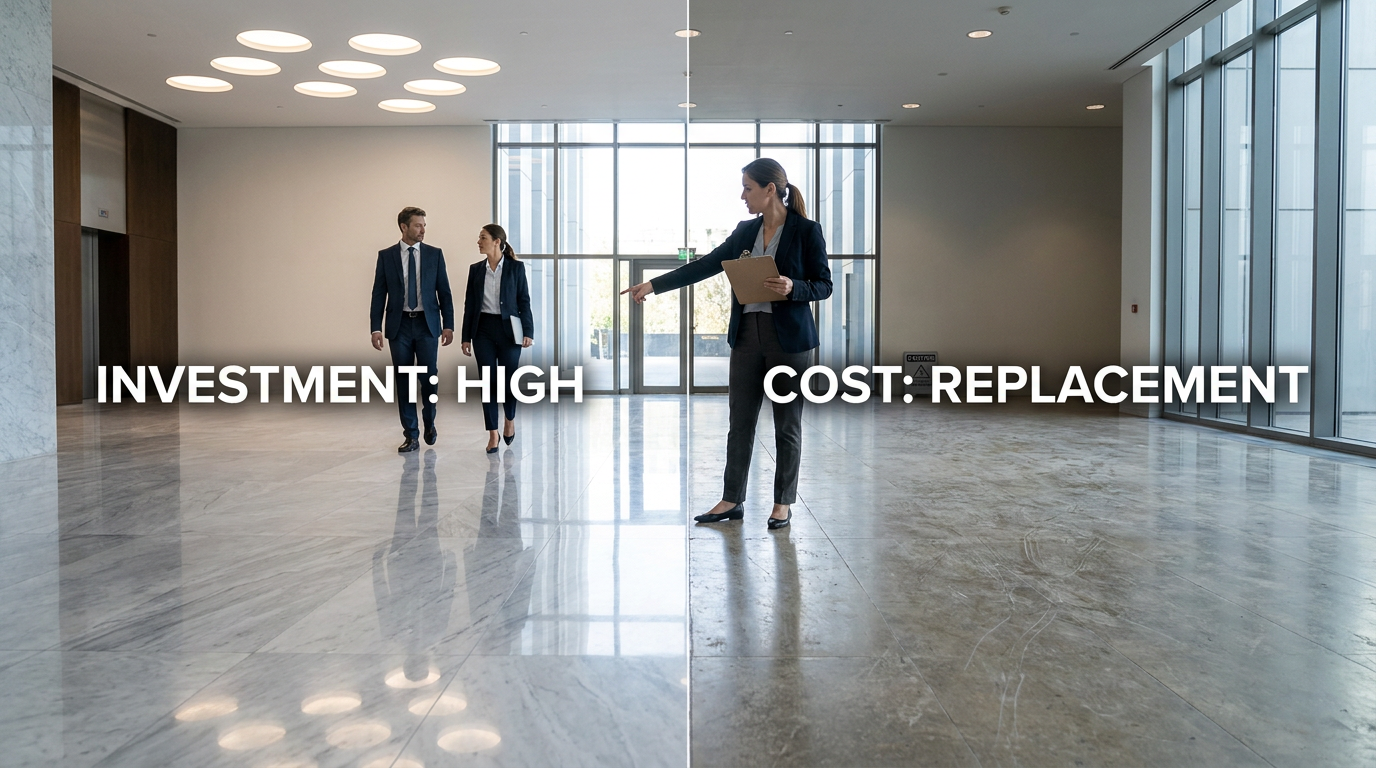
Preventive commercial floor maintenance programs deliver 300-545% ROI by extending floor lifespan 40-60% and reducing emergency repair costs by up to 80%. A 10,000 square foot facility investing $3,500-$6,000 annually in scheduled maintenance avoids $15,000-$25,000 in premature replacement costs over a five-year period.
- Preventive maintenance saves $5-$10 for every $1 invested compared to reactive repairs
- VCT floors last 15-20 years with maintenance versus 8-10 years without, saving $45,000+ per 10,000 sq ft
- Strip and wax cycles cost $0.80-$1.20/sq ft versus $3-$8/sq ft for full floor replacement
- Quarterly scrub and recoat at $0.35-$0.55/sq ft extends time between full strip cycles by 50%
- Payback period for preventive programs averages 8-14 months for most commercial facilities
What Preventive Floor Maintenance Actually Costs
Preventive floor maintenance costs vary by floor type, facility size, and service frequency. According to Re-Leased property management research, facilities that implement structured maintenance programs spend 12-18% less annually than those using reactive approaches. Understanding these costs allows facility managers to build accurate budgets and calculate true ROI.
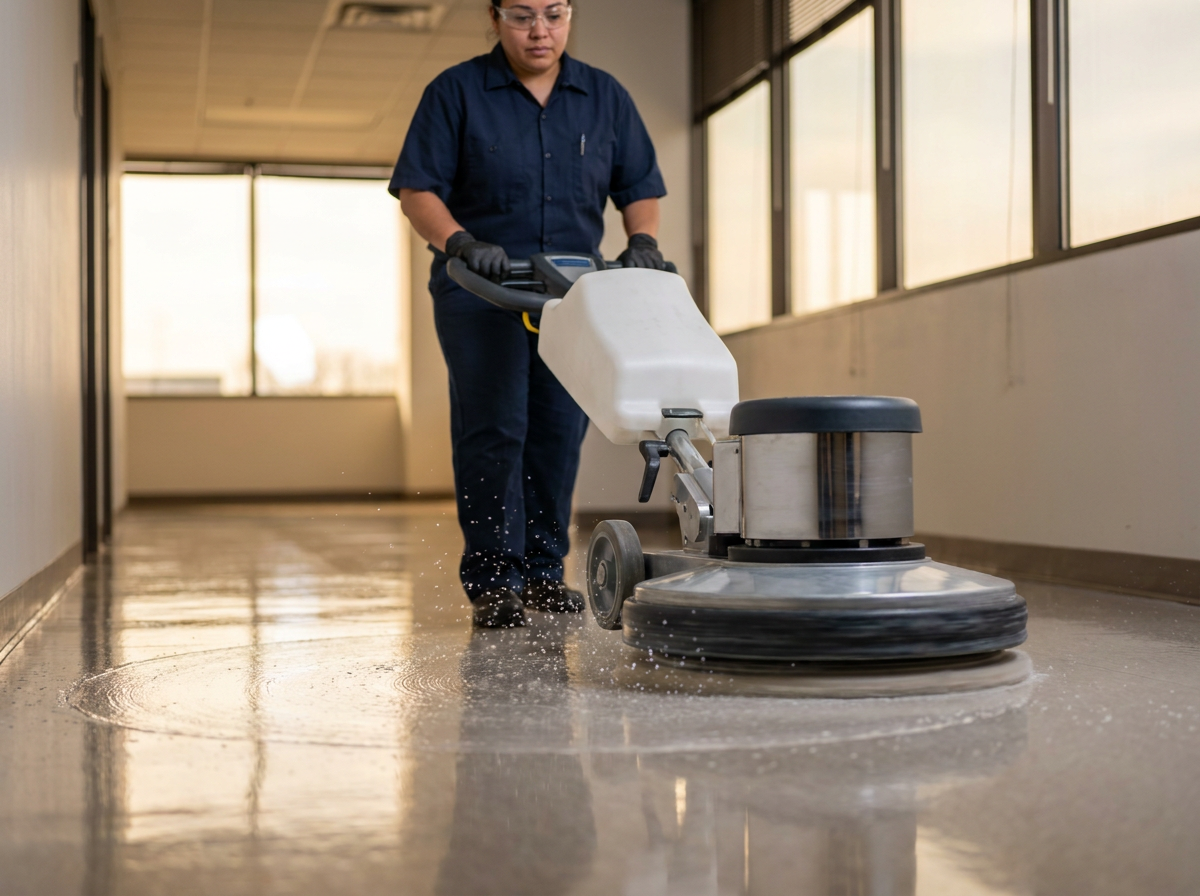
For VCT and LVT flooring, the most common commercial floor types, annual maintenance costs break down into three primary service categories. Commercial floor stripping and waxing represents the largest single expense at $0.80-$1.20 per square foot, typically performed every 6-12 months depending on traffic levels.
Between full strip cycles, commercial floor scrubbing and waxing refreshes the finish at $0.35-$0.55 per square foot. Most facilities schedule this service every 3-6 months. Regular deep cleaning with auto-scrubbers costs $0.15-$0.30 per square foot monthly.
| Service Type | Cost per Sq Ft | Frequency | Annual Cost (10,000 sq ft) |
|---|---|---|---|
| Strip and Wax | $0.80-$1.20 | Every 6-12 months | $1,600-$2,400 |
| Scrub and Recoat | $0.35-$0.55 | Every 3-6 months | $1,400-$2,200 |
| Deep Cleaning | $0.15-$0.30 | Monthly | $1,800-$3,600 |
| Total Annual Investment | - | - | $4,800-$8,200 |
Calculating ROI: The Standard Formula
The International Facility Management Association (IFMA) provides a straightforward ROI calculation method in their economic value of preventive maintenance study. The formula divides net savings by total program investment, then multiplies by 100 to express as a percentage.
ROI Formula: (Total Savings - Program Cost) / Program Cost x 100 = ROI %
For floor maintenance specifically, total savings include avoided replacement costs, reduced emergency repairs, extended asset lifespan value, and decreased slip-and-fall liability exposure. Program costs include all scheduled maintenance services, materials, and any equipment investments.
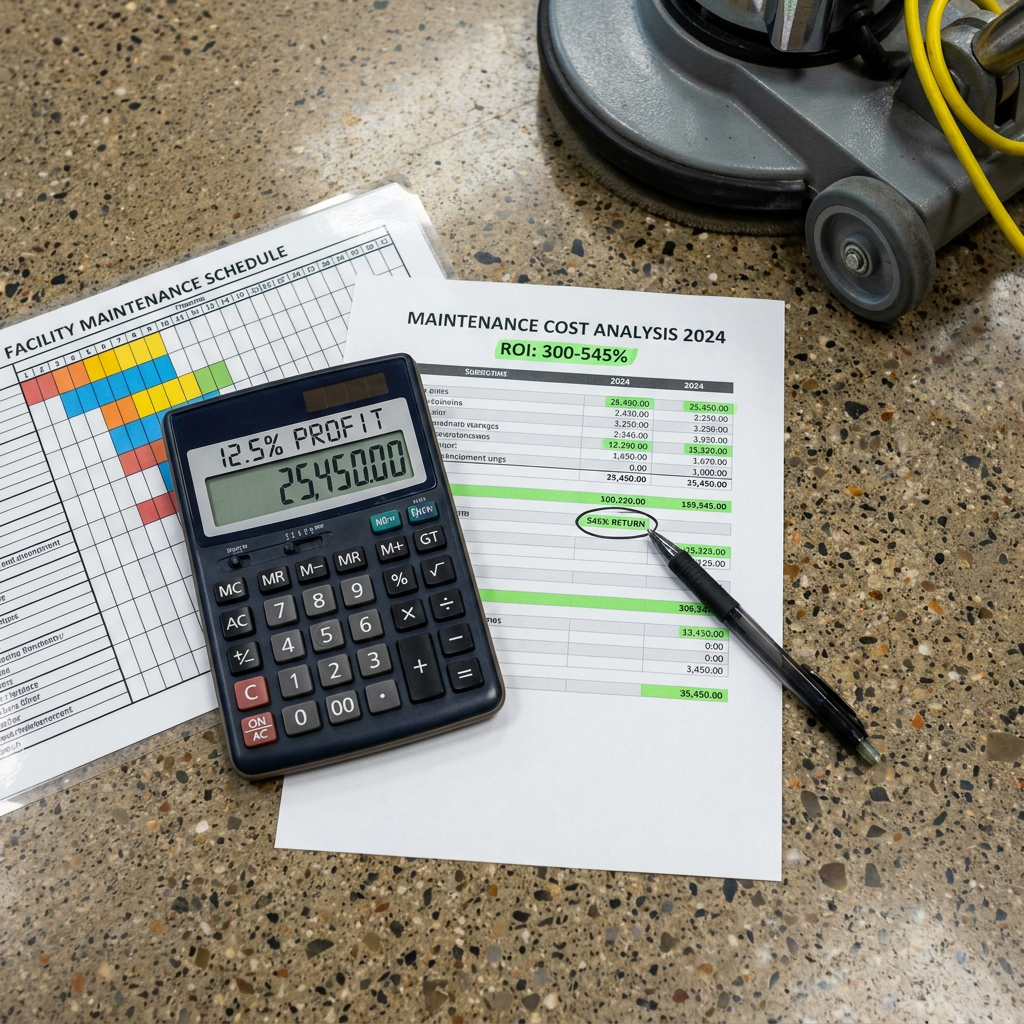
A practical example: A 15,000 square foot medical office spends $7,200 annually on preventive floor maintenance. Without maintenance, the VCT flooring would require replacement in 9 years at $52,500 ($3.50/sq ft installed). With maintenance, the floor lasts 18 years. The deferred replacement value equals $52,500 spread over 9 additional years, or $5,833 annually. ROI calculation: ($5,833 - $7,200 + $2,400 avoided repairs) / $7,200 x 100 = 14.3% first-year ROI, increasing to 143% by year five as replacement deferral compounds.
Reactive Versus Preventive: A Five-Year Cost Comparison
Research from Gatewise property management demonstrates that reactive maintenance costs 5-10 times more than preventive approaches over a building's lifecycle. For commercial flooring specifically, the gap narrows but remains substantial at 3-4 times higher costs for reactive strategies.
Reactive floor maintenance means waiting until visible damage occurs before taking action. This approach leads to accelerated wear patterns, permanent staining, and structural damage to flooring substrates. Once VCT loses its protective finish layer, moisture penetrates the tile, causing delamination and requiring full replacement rather than refinishing.
The cost difference becomes dramatic over a five-year period. A 20,000 square foot retail space using reactive maintenance spends approximately $8,000-$12,000 annually on emergency repairs and spot treatments. The same facility using preventive maintenance spends $9,600-$16,400 annually but avoids a $70,000 floor replacement that reactive facilities typically face in years 4-5.
| Cost Category | Reactive (5-Year Total) | Preventive (5-Year Total) |
|---|---|---|
| Scheduled Maintenance | $0 | $48,000-$82,000 |
| Emergency Repairs | $40,000-$60,000 | $4,000-$8,000 |
| Floor Replacement | $70,000 | $0 |
| Five-Year Total | $110,000-$130,000 | $52,000-$90,000 |
ROI by Floor Type: VCT, LVT, Terrazzo, and Tile
Different flooring materials respond to preventive maintenance with varying ROI profiles. Understanding these differences helps facility managers prioritize maintenance budgets and set realistic expectations for each floor type in their buildings.
VCT (Vinyl Composition Tile)
VCT delivers the highest maintenance ROI because the material depends entirely on applied finish for protection. According to Lake City Janitorial research, properly maintained VCT lasts 20-25 years versus 8-12 years without maintenance. The ROI calculation favors preventive care heavily: $0.48/sq ft annual maintenance cost versus $3.50/sq ft replacement cost spread over the extended lifespan equals 380-420% ROI.
For South Florida facilities, extending commercial floor finish lifespan requires accounting for humidity effects on cure times and finish adhesion. Facilities in Miami-Dade, Broward, and Palm Beach Counties should schedule strip and wax services during lower humidity periods when possible.
LVT (Luxury Vinyl Tile)
LVT requires less intensive maintenance than VCT but still benefits from preventive care. The factory-applied wear layer eliminates the need for traditional waxing, but regular deep cleaning and periodic refinishing extend lifespan from 15 years to 25+ years. ROI ranges from 180-250% over a ten-year period. Review the detailed VCT vs LVT commercial flooring comparison for complete cost analysis.
Marble and Terrazzo
Natural stone and terrazzo floors represent significant capital investments, often $15-$40 per square foot installed. Commercial marble and terrazzo polishing using diamond honing techniques costs $2-$5 per square foot annually but extends floor lifespan indefinitely when properly maintained. ROI exceeds 500% over 20 years because well-maintained stone never requires replacement.
Ceramic and Porcelain Tile
Tile flooring ROI focuses primarily on grout maintenance rather than the tile surface itself. Commercial tile and grout cleaning at $0.50-$1.50 per square foot prevents grout deterioration that leads to tile loosening and water damage. Annual maintenance investment of $1,500-$4,500 for a 3,000 square foot restroom area prevents $15,000-$25,000 in tile replacement and water damage repairs.
Hidden ROI Factors Most Calculations Miss
Standard ROI calculations capture direct cost savings but miss several significant value categories. Including these factors often doubles or triples the apparent ROI of preventive floor maintenance programs.
Slip-and-Fall Liability Reduction
The National Floor Safety Institute reports that slip-and-fall accidents cost businesses an average of $40,000 per incident in direct costs. Properly maintained floors with appropriate coefficient of friction reduce incident rates by 50-70%. For a facility averaging two incidents annually, preventive maintenance delivering $40,000-$56,000 in avoided liability represents ROI that rarely appears in standard calculations.
Business Disruption Avoidance
Emergency floor repairs require closing affected areas for 24-72 hours. For retail spaces generating $200-$500 per square foot annually, a 2,000 square foot closure costs $1,096-$2,740 in lost revenue per day. Preventive maintenance eliminates most emergency situations, preserving revenue that reactive approaches sacrifice.
Professional Image and Tenant Retention
Commercial property managers report that floor condition ranks among the top three factors tenants cite when deciding to renew leases. BOMA International research indicates that well-maintained common areas reduce tenant turnover by 15-25%. For a 50,000 square foot Class A office building with $35/sq ft rents, each avoided turnover saves $87,500-$175,000 in vacancy loss and tenant improvement costs.
Indoor Air Quality Connection
Degraded floor finishes trap and release particulates that compromise indoor air quality. Facilities maintaining floor finishes properly report 20-30% fewer air quality complaints. Combining floor maintenance with commercial air duct cleaning creates compounding air quality improvements that reduce sick building syndrome incidents.
Building Your Preventive Maintenance Program
Effective preventive floor maintenance programs require documented schedules, clear service specifications, and regular performance measurement. The most successful programs include quarterly reviews and annual adjustments based on actual floor condition assessments.
Step 1: Baseline Assessment
Before establishing a maintenance schedule, document current floor conditions with photographs and written assessments. Note existing damage, wear patterns, and finish thickness. This baseline enables accurate ROI measurement by providing before-and-after comparison data. Most professional floor care providers offer free on-site assessments that include this documentation.
Step 2: Traffic Analysis
Map traffic patterns throughout your facility to identify high-wear zones requiring more frequent attention. Entrances, main corridors, elevator lobbies, and checkout areas typically need 2-3 times more frequent maintenance than secondary spaces. Concentrating resources on high-traffic zones maximizes ROI by preventing damage where it occurs fastest.
Step 3: Service Schedule Development
Build maintenance schedules around your facility's operational patterns. Healthcare facilities benefit from overnight and weekend scheduling to minimize patient disruption. Retail spaces schedule intensive services during closed hours. Review the office cleaning checklist for facility managers for scheduling framework templates.
Step 4: Vendor Selection
Choose vendors with proper insurance coverage, documented training programs, and verifiable references in your industry. The commercial cleaning insurance requirements checklist details the coverage levels and documentation you should require from any floor maintenance provider.
Measuring Program Success
Track these metrics monthly to verify your preventive maintenance program delivers expected ROI. Adjust service frequencies and methods based on data rather than assumptions.
Finish Thickness: Measure floor finish depth quarterly using a mil gauge. Properly maintained VCT should maintain 3-5 mils of finish. Readings below 2 mils indicate the need for additional coats or more frequent recoating.
Gloss Readings: Use a gloss meter to track finish appearance objectively. New finish reads 80-90 gloss units. Schedule scrub and recoat when readings drop below 50 units. Schedule full strip and wax when readings fall below 30 units despite recoating.
Incident Reports: Track slip-and-fall incidents, complaints, and near-misses. Effective programs show declining incident rates within 6-12 months of implementation.
Cost Per Square Foot: Calculate total annual floor maintenance cost divided by maintained square footage. Compare against industry benchmarks of $0.48-$0.82 per square foot annually for comprehensive VCT programs.
Frequently Asked Questions
How long before preventive floor maintenance shows positive ROI?
Most facilities see positive ROI within 8-14 months of implementing preventive programs. The first full strip and wax cycle establishes a protective baseline, and subsequent maintenance builds on that foundation. By month 18-24, cumulative savings from avoided repairs and extended replacement timelines typically exceed total program investment to date.
Does preventive maintenance make sense for facilities planning renovation in 3-5 years?
Yes, but with modified expectations. Even facilities planning renovation benefit from maintaining professional appearance and avoiding liability during the interim period. Reduce service frequency to maintenance minimums: annual strip and wax, semi-annual scrub and recoat, and monthly deep cleaning. This approach costs 40-50% less than full preventive programs while maintaining acceptable conditions.
How does South Florida climate affect floor maintenance ROI?
South Florida's humidity and temperature extremes accelerate floor finish degradation by 15-25% compared to climate-controlled environments. Facilities in Miami-Dade, Broward, and Palm Beach Counties should budget for more frequent maintenance cycles. The summer cleaning challenges for South Florida buildings guide addresses specific humidity-related maintenance adjustments.
What ROI can healthcare facilities expect from preventive floor maintenance?
Healthcare facilities typically see 400-545% ROI from preventive floor maintenance due to stringent infection control requirements and higher liability exposure. The combination of regulatory compliance, patient safety, and professional image requirements makes preventive maintenance essentially mandatory rather than optional. Review the 72-hour health inspection cleaning protocol for healthcare-specific maintenance standards.
Should I include carpet maintenance in floor ROI calculations?
Yes. Commercial carpet replacement costs $4-$12 per square foot installed. Regular commercial carpet cleaning at $0.15-$0.35 per square foot quarterly extends carpet lifespan from 5-7 years to 10-15 years. Include carpet areas in total floor maintenance ROI calculations for accurate facility-wide analysis.
Get Your Free Floor Assessment and ROI Analysis
MB Floor Solutions provides complimentary on-site assessments with detailed cost projections for commercial facilities across Miami-Dade, Broward, and Palm Beach Counties. Our team will document current floor conditions, recommend appropriate maintenance schedules, and calculate expected ROI for your specific facility.
Schedule Your Free Assessment