Commercial carpet cleaning costs $0.15-$0.35/sq ft while replacement runs $2.50-$8.00/sq ft. Learn when to clean vs replace with our facility manager guide.
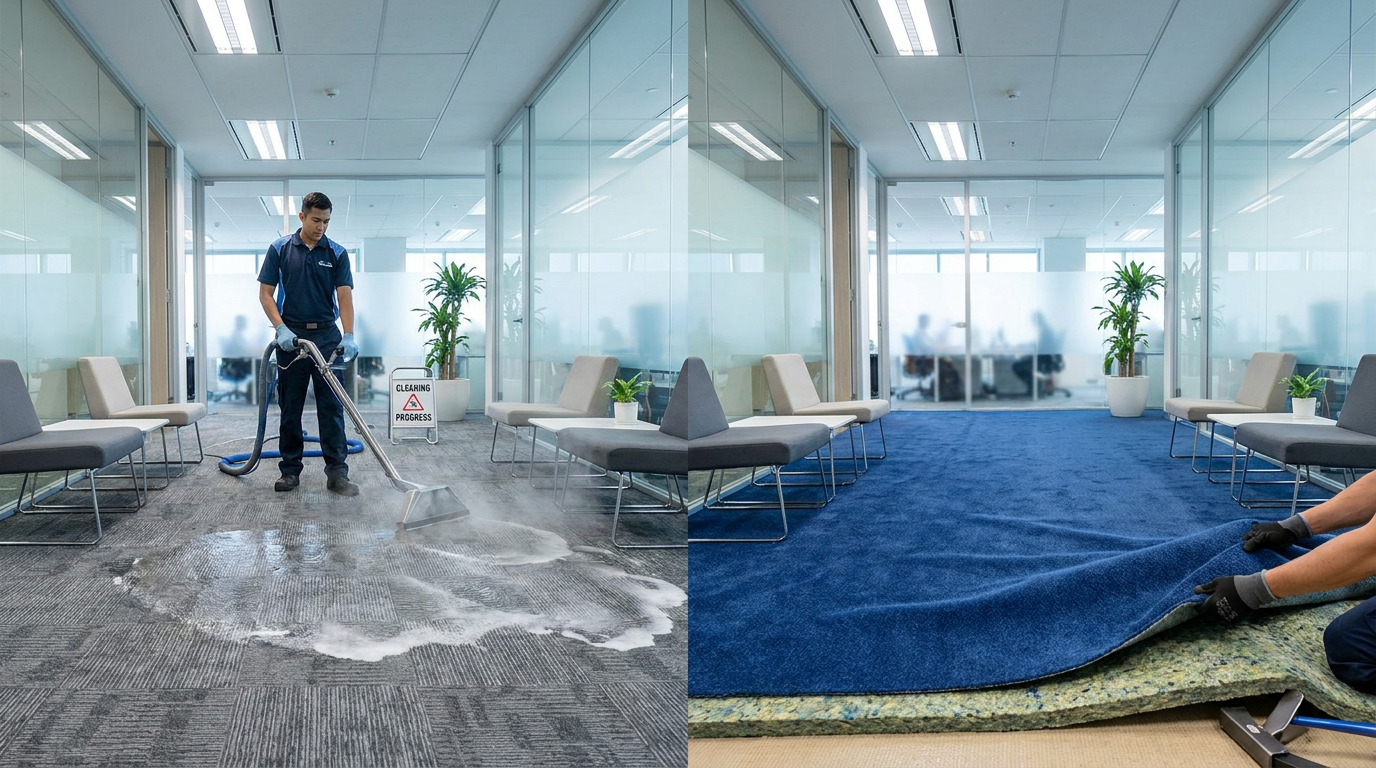
Commercial carpet cleaning costs $0.15 to $0.35 per square foot, while full replacement runs $2.50 to $8.00 per square foot installed. For a 10,000 square foot facility, that translates to $1,500 to $3,500 for professional cleaning versus $25,000 to $80,000 for new carpet. Cleaning is almost always the right choice unless structural damage, permanent staining, or backing failure makes restoration impossible.
- Cleaning costs $0.15 to $0.35 per square foot; replacement costs $2.50 to $8.00 per square foot installed
- Professional cleaning every 3 to 6 months extends carpet life by 3 to 5 years
- Replace when backing delaminates, odors persist after restorative cleaning, or fiber wear prevents appearance recovery
- High-traffic areas (retail, healthcare, schools) need cleaning every 4 to 8 weeks to prevent premature replacement
- Deferred maintenance accelerates wear; embedded grit abrades fibers with every footstep
Complete Cost Comparison: Cleaning vs Replacement
The financial gap between maintaining commercial carpet and replacing it is substantial. According to industry pricing data, commercial carpet cleaning typically ranges from $0.15 to $0.35 per square foot depending on soil level, fiber type, and cleaning method. Replacement costs, by contrast, start at $2.50 per square foot for basic commercial broadloom and climb to $8.00 or higher for premium carpet tile with installation, removal, and disposal included.
For facility managers in South Florida's Miami-Dade, Broward, and Palm Beach counties, these numbers translate directly into budget decisions. A 15,000 square foot office building faces a cleaning cost of $2,250 to $5,250 versus a replacement cost of $37,500 to $120,000. That difference funds years of professional maintenance.
| Cost Category | Cleaning | Replacement |
|---|---|---|
| Cost per square foot | $0.15 to $0.35 | $2.50 to $8.00 |
| 5,000 sq ft facility | $750 to $1,750 | $12,500 to $40,000 |
| 10,000 sq ft facility | $1,500 to $3,500 | $25,000 to $80,000 |
| 25,000 sq ft facility | $3,750 to $8,750 | $62,500 to $200,000 |
| Typical frequency | Every 3 to 6 months | Every 7 to 15 years |
| Downtime required | 1 to 4 hours dry time | 2 to 5 days per zone |
How Professional Cleaning Extends Carpet Life
Regular professional cleaning extends commercial carpet life by 3 to 5 years, according to commercial carpet maintenance research. This extension comes from removing embedded soil before it damages fibers. Every footstep grinds tracked-in grit against carpet fibers, creating microscopic cuts that accumulate into visible wear patterns.
The Carpet and Rug Institute (CRI) recommends a three-tier maintenance approach: daily vacuuming removes 79% of dry soil, interim cleaning every 2 to 8 weeks addresses traffic lanes, and restorative deep cleaning every 6 to 12 months removes embedded contamination. Facilities that follow this protocol consistently outperform those that clean only when carpet looks dirty.
Low-moisture bonnet cleaning, the method used by commercial carpet cleaning services in South Florida, offers particular advantages for business environments. Dry times of 1 to 2 hours minimize operational disruption, and the process lifts soil without saturating backing materials that can harbor mold in humid climates like Miami.
Seven Warning Signs Your Carpet Needs Replacement
Cleaning cannot fix structural damage. When carpet reaches certain failure points, replacement becomes the only practical option. Facility managers should watch for these specific indicators that signal end-of-life conditions.
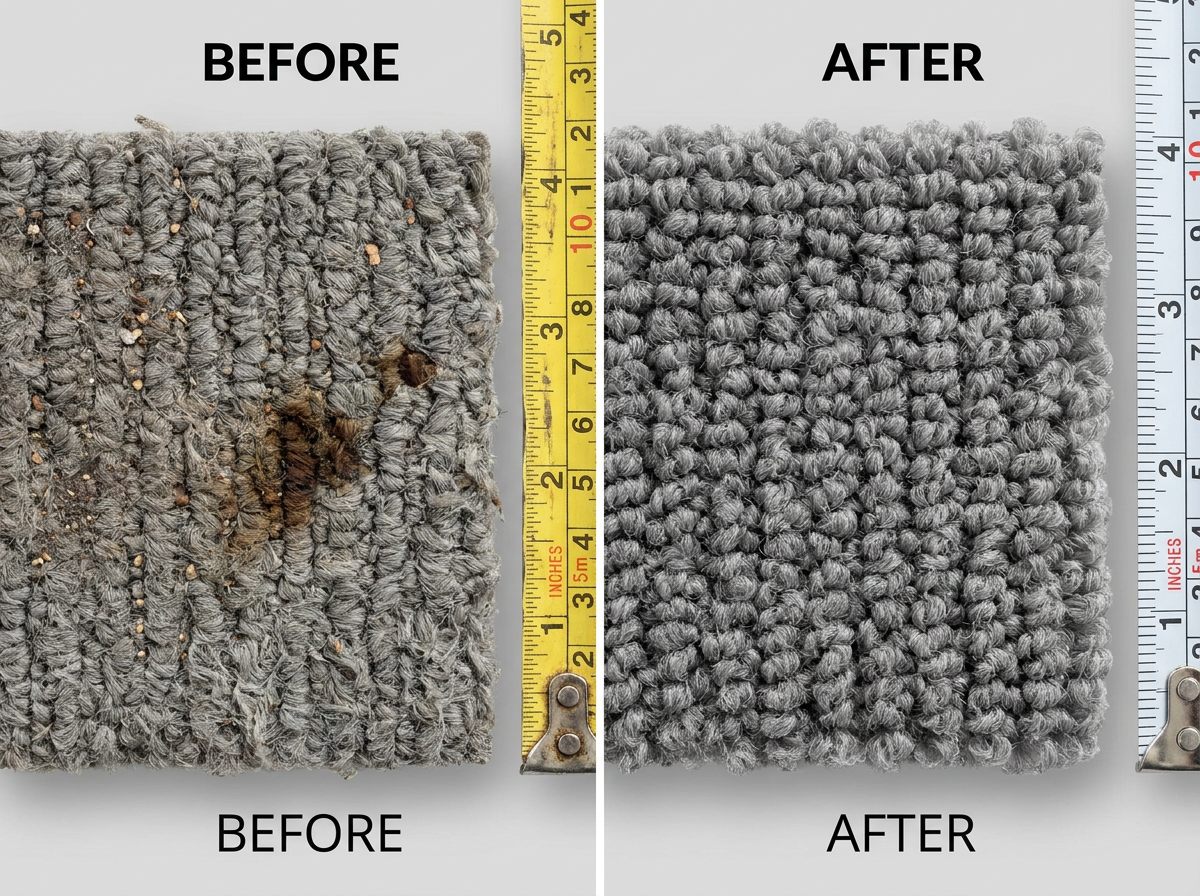
Backing delamination occurs when the secondary backing separates from the primary backing. You will notice ripples, bubbles, or areas where carpet lifts from the subfloor. This condition creates trip hazards and cannot be reversed through cleaning.
Permanent fiber matting happens when pile fibers lose their ability to recover after compression. If traffic lanes remain flat after professional cleaning and grooming, the carpet has exceeded its useful life. Nylon fibers typically last 10 to 15 years in commercial settings; olefin and polyester last 5 to 10 years.
Persistent odor after restorative cleaning indicates contamination has penetrated the backing or pad. Common causes include water damage, pet accidents in buildings that previously allowed animals, or biological contamination. If professional enzyme treatment and extraction fail to eliminate odors, the carpet must be replaced.
Visible subfloor through worn areas means fiber loss has progressed beyond recovery. This typically appears first at pivot points near doors, elevator lobbies, and reception desks where foot traffic concentrates.
Widespread staining covering more than 30% of visible area suggests the carpet has absorbed more contamination than cleaning can address. Isolated stains respond to spot treatment; widespread discoloration indicates systemic failure.
Seam separation or fraying creates both appearance and safety issues. While seams can sometimes be repaired, extensive separation across multiple areas signals installation failure or backing deterioration.
Indoor air quality complaints that persist after cleaning may indicate the carpet has become a reservoir for allergens, dust mites, or mold spores that cleaning cannot fully remove. Healthcare facilities and schools face particular scrutiny on this issue.

Cleaning Frequency by Building Type
Different commercial environments generate different soil loads. The Institute of Inspection, Cleaning and Restoration Certification (IICRC) S100 standard provides guidance that facility managers can adapt to their specific conditions. According to industry ROI analysis, matching cleaning frequency to actual traffic patterns optimizes both carpet life and maintenance budgets.
| Building Type | Interim Cleaning | Deep Cleaning | Expected Carpet Life |
|---|---|---|---|
| Low-traffic office | Every 6 to 8 weeks | Every 12 months | 12 to 15 years |
| High-traffic office | Every 4 to 6 weeks | Every 6 months | 8 to 12 years |
| Retail store | Every 2 to 4 weeks | Every 3 to 6 months | 5 to 8 years |
| Healthcare clinic | Every 2 to 4 weeks | Every 3 months | 7 to 10 years |
| School or university | Every 2 to 4 weeks | Every 3 to 4 months | 6 to 10 years |
| Call center | Every 2 to 3 weeks | Every 3 months | 5 to 7 years |
| Restaurant dining area | Weekly | Monthly | 3 to 5 years |
South Florida facilities face additional challenges from humidity and sand tracked in from beaches and construction sites. The summer cleaning challenges unique to South Florida buildings include accelerated mold growth in carpet backing when moisture is not properly managed during cleaning.
The True Cost of Deferred Maintenance
Skipping scheduled cleanings does not save money. According to facility cost research, deferred carpet maintenance accelerates replacement timelines and increases total cost of ownership. Each month of delayed cleaning allows embedded grit to cut fibers, pushing the carpet closer to irreversible damage.
Consider a 10,000 square foot office with nylon broadloom carpet. With proper maintenance (cleaning every 3 to 6 months at $0.25 per square foot), annual cleaning costs total $5,000 to $10,000. Over a 12-year carpet life, total cleaning investment reaches $60,000 to $120,000, plus the original $50,000 installation.
Without proper maintenance, that same carpet may require replacement at year 7. The facility now faces a $50,000 replacement cost five years early, plus the disruption of installation. The apparent savings from skipped cleanings disappear entirely, replaced by premature capital expense.
This calculation becomes even more compelling when you factor in operational disruption. Carpet replacement requires furniture removal, employee displacement, and 2 to 5 days of limited access per zone. Professional cleaning with low-moisture methods allows normal operations to resume within 1 to 2 hours.
Lifecycle ROI: A 10-Year Cost Model
Facility managers evaluating carpet cleaning versus replacement need concrete numbers. The following model compares two approaches for a 10,000 square foot commercial space over a 10-year period.
Scenario A: Regular Professional Cleaning
- Initial carpet installation: $40,000 (year 0)
- Deep cleaning twice yearly at $0.25/sq ft: $5,000 per year
- 10-year cleaning total: $50,000
- Carpet replacement: Not required (carpet reaches year 10 in serviceable condition)
- Total 10-year cost: $90,000
Scenario B: Minimal Maintenance
- Initial carpet installation: $40,000 (year 0)
- Deep cleaning once yearly at $0.25/sq ft: $2,500 per year
- 6-year cleaning total: $15,000
- Carpet replacement at year 6: $45,000 (including removal and disposal)
- Deep cleaning years 7 to 10: $10,000
- Total 10-year cost: $110,000
The facility that invested more in cleaning saved $20,000 over the decade while avoiding the operational disruption of mid-cycle replacement. This model does not account for potential productivity losses, tenant complaints, or accelerated wear on the second carpet from continued minimal maintenance.
Commercial Carpet Cleaning Methods Compared
Not all cleaning methods deliver equal results. The choice between extraction, encapsulation, and bonnet cleaning affects both immediate appearance and long-term carpet health. Understanding these differences helps facility managers specify appropriate service levels.
Hot water extraction (sometimes called steam cleaning) injects heated cleaning solution into carpet fibers and immediately extracts it along with dissolved soil. This method removes the most contamination but requires 6 to 24 hours of dry time. It works best for annual restorative cleaning in facilities that can schedule weekend service.
Encapsulation cleaning uses crystallizing polymers that surround soil particles and dry to a britite residue. Subsequent vacuuming removes the encapsulated soil. Dry time is 20 to 45 minutes, making this method suitable for occupied spaces. Encapsulation works well for interim maintenance between extraction cycles.
Bonnet cleaning uses a rotary machine with absorbent pads to lift soil from carpet surfaces. This low-moisture method offers the fastest dry times (1 to 2 hours) and minimal disruption. Professional bonnet cleaning services are particularly effective for maintaining traffic lanes between deeper cleanings.
The IICRC recommends combining methods based on soil conditions. A typical commercial maintenance program might include weekly vacuuming, monthly bonnet cleaning of traffic lanes, quarterly encapsulation of full carpet areas, and annual hot water extraction.
Decision Framework: Clean or Replace?
Use this systematic approach to evaluate whether your commercial carpet needs cleaning or replacement. Score each factor, then total your results.
Fiber Condition (0 to 25 points)
- Fibers spring back after compression: 25 points (clean)
- Some matting in traffic lanes, recovers partially: 15 points (clean with caution)
- Permanent matting, no recovery: 5 points (consider replacement)
- Visible backing through worn areas: 0 points (replace)
Staining (0 to 25 points)
- No permanent stains or minor isolated spots: 25 points (clean)
- Moderate staining under 15% of area: 15 points (clean with spot treatment)
- Significant staining 15% to 30% of area: 10 points (restorative cleaning, then evaluate)
- Widespread staining over 30%: 0 points (replace)
Structural Integrity (0 to 25 points)
- Backing intact, seams secure, no ripples: 25 points (clean)
- Minor seam issues, repairable: 15 points (repair and clean)
- Multiple seam failures or small delamination areas: 5 points (consider replacement)
- Widespread delamination or buckling: 0 points (replace)
Odor (0 to 25 points)
- No odor issues: 25 points (clean)
- Mild odor that responds to treatment: 15 points (clean with enzyme treatment)
- Persistent odor after professional cleaning: 5 points (replace)
- Severe odor indicating contamination: 0 points (replace)
Scoring Results:
- 75 to 100 points: Professional cleaning will restore appearance and extend life
- 50 to 74 points: Restorative cleaning recommended; reassess in 6 months
- 25 to 49 points: Cleaning may provide temporary improvement; budget for replacement within 12 to 24 months
- 0 to 24 points: Replacement is the cost-effective choice
Preparing for Professional Carpet Cleaning
Maximize the value of professional cleaning by preparing your facility properly. These steps ensure technicians can work efficiently and deliver optimal results.
Clear small items from carpeted areas 24 hours before service. Remove trash cans, floor fans, small furniture, and items stored on carpet. Professional crews can work around desks and large furniture, but clearing the space improves access to traffic lanes and edges.
Identify and communicate specific problem areas. Point out stubborn stains, high-traffic zones, and areas with odor concerns. This information helps technicians apply appropriate pre-treatments and allocate time effectively.
Schedule cleaning for periods of lowest occupancy. After-hours and overnight service minimizes disruption and allows maximum dry time before employees return. Most commercial cleaning companies offer flexible scheduling for this reason.
Plan for ventilation. Open windows or increase HVAC airflow during and after cleaning to accelerate drying. In South Florida's humid climate, running air conditioning helps prevent moisture from lingering in carpet backing.
Questions Facility Managers Should Ask Cleaning Vendors
Before contracting carpet cleaning services, verify the vendor's qualifications and approach. These questions help distinguish professional operators from inexperienced providers.
What cleaning method do you recommend for my carpet type and soil conditions? A qualified vendor will assess your specific situation rather than offering a one-size-fits-all approach. They should explain why their recommended method suits your needs.
What is your expected dry time, and how do you minimize it? Professional operators use air movers and calibrated extraction to control moisture. Vague answers suggest inadequate equipment or training.
Are you IICRC certified? The Institute of Inspection, Cleaning and Restoration Certification sets industry standards. Certified technicians have demonstrated competency in carpet cleaning methods and fiber identification.
Do you carry liability insurance and can you provide a Certificate of Insurance? Legitimate commercial cleaning companies maintain general liability coverage and can provide COI documentation. The commercial cleaning insurance requirements protect both parties in case of damage or injury.
What is your process for pre-treating stains and high-traffic areas? Effective cleaning requires targeted pre-treatment. Vendors who skip this step deliver inferior results.
When Replacement Makes Financial Sense
Despite the cost advantage of cleaning, replacement becomes the economically rational choice under specific circumstances. Recognizing these situations prevents throwing money at carpet that cannot be saved.
Calculate your break-even point. If restorative cleaning costs approach 40% to 50% of replacement cost and the carpet will still need replacement within 2 years, immediate replacement may be more cost-effective. This calculation changes based on carpet age, condition, and remaining useful life.
Consider tenant expectations and brand standards. A Class A office building in Miami or Fort Lauderdale cannot present worn carpet to prospective tenants regardless of structural condition. In competitive leasing environments, carpet appearance directly affects rental rates and vacancy.
Factor in indoor air quality requirements. Healthcare facilities, schools, and buildings with occupants who have respiratory sensitivities may need to replace carpet that has accumulated allergens beyond what cleaning can remove. The cleaning compliance requirements for educational facilities increasingly emphasize indoor air quality.
Account for renovation timing. If your facility has planned renovations within 12 to 24 months, coordinating carpet replacement with other work reduces total disruption and may qualify for contractor pricing efficiencies.
Carpet Tile vs Broadloom: Replacement Considerations
Modern commercial facilities increasingly specify carpet tile instead of broadloom. This choice affects both cleaning and replacement economics in ways facility managers should understand.
Carpet tile allows targeted replacement. When a section of carpet tile suffers irreparable damage, you can replace individual tiles rather than entire rooms. This capability reduces replacement costs by 60% to 80% compared to broadloom in many scenarios.
However, carpet tile requires inventory management. Facilities must maintain replacement stock in matching dye lots, as manufacturers cannot guarantee color consistency across production runs. Budget 10% to 15% overage at initial installation for future repairs.
Cleaning economics remain similar between formats. Both carpet tile and broadloom respond to the same cleaning methods at comparable per-square-foot costs. The difference emerges at replacement, not maintenance.
Integrating Carpet Care with Overall Floor Maintenance
Commercial facilities typically contain multiple flooring types. Coordinating carpet cleaning with hard floor maintenance optimizes scheduling and reduces total facility management costs.
Schedule carpet cleaning to follow hard floor work. Stripping and waxing VCT or deep cleaning hard floors can splash cleaning solution onto adjacent carpet. Cleaning carpet last ensures no cross-contamination.
Use the same vendor for multiple floor types when possible. Single-source providers understand your facility's complete flooring inventory and can coordinate service schedules. This approach also simplifies vendor management and invoice processing.
Apply entrance matting strategies to protect both carpet and hard floors. Quality walk-off mats capture 80% to 90% of tracked-in soil within the first 12 to 15 feet of building entry. This investment reduces cleaning frequency and extends life for all flooring types. Learn more about extending commercial floor finish lifespan through strategic matting and maintenance.
Getting Started: Next Steps for Your Facility
Evaluate your commercial carpet using the decision framework above. Score each factor honestly, then determine whether cleaning or replacement serves your facility's needs and budget.
For carpet scoring 50 points or higher, schedule a professional assessment to develop a maintenance program matched to your traffic patterns and soil conditions. Request pricing for both interim cleaning and restorative deep cleaning so you can budget appropriately.
For carpet scoring below 50 points, obtain replacement quotes while also getting a restorative cleaning estimate. Compare the cost of extending carpet life by 12 to 24 months through intensive cleaning against the full replacement investment.
South Florida facility managers can request a free on-site assessment from MB Floor Solutions to evaluate carpet condition and receive a written quote for professional cleaning services. Our technicians serve commercial facilities throughout Miami-Dade, Broward, and Palm Beach counties with after-hours scheduling to minimize business disruption.
Get a Free Carpet Assessment
MB Floor Solutions provides professional commercial carpet cleaning throughout South Florida. Request your free on-site assessment and written quote to determine the best approach for your facility.
Schedule Your Free Assessment