Learn school and university cleaning requirements, compliance standards, and best practices. Covers CDC guidelines, floor care schedules, and IAQ protocols.
Schools and universities must follow specific cleaning protocols established by the CDC, EPA, and state health departments to maintain safe learning environments. Compliance requires daily disinfection of high-touch surfaces, proper floor maintenance schedules, and documented cleaning logs that demonstrate adherence to OSHA and local health codes.
- CDC recommends disinfecting high-touch surfaces at least once daily in educational facilities
- VCT floors in schools require stripping and waxing every 6 to 12 months depending on foot traffic
- ASHRAE Standard 62.1 mandates minimum ventilation rates of 10 CFM per person in classrooms
- Florida Department of Health requires documented cleaning logs for school inspection compliance
- EPA-registered disinfectants must have contact times of 1 to 10 minutes for pathogen elimination
Federal and State Compliance Requirements for Educational Facilities
Educational institutions in Florida must comply with overlapping federal and state regulations. The EPA establishes guidelines for routine cleaning and maintenance that apply to K-12 schools and universities. These protocols address everything from chemical storage to disinfectant selection.
The Florida Department of Education mandates that all public schools maintain sanitary conditions meeting Florida Administrative Code Chapter 64E-13 standards. This includes specific requirements for restroom cleaning frequency, cafeteria sanitation, and gymnasium floor maintenance.
OSHA’s Bloodborne Pathogen Standard (29 CFR 1910.1030) requires schools to have exposure control plans. Staff must receive annual training on proper cleaning procedures for bodily fluid spills. Documentation of this training must be maintained for three years.
Daily Cleaning Protocols for High-Touch Surfaces
High-touch surfaces in schools accumulate 80% more bacteria than low-touch areas, according to research from the American Journal of Infection Control. These surfaces require attention multiple times throughout the school day, not just after hours.
Door handles, light switches, desk surfaces, and shared equipment need disinfection every 2 to 4 hours during active use. Restroom fixtures require cleaning at minimum every 4 hours during school hours, with complete disinfection after the school day ends.
| Surface Type | Minimum Frequency | Required Contact Time |
|---|---|---|
| Door handles and push plates | Every 2 to 4 hours | 1 to 3 minutes |
| Student desks and tables | Between class periods | 3 to 5 minutes |
| Restroom fixtures | Every 4 hours minimum | 5 to 10 minutes |
| Shared electronics and keyboards | After each user | 1 to 2 minutes |
| Water fountains | Every 2 hours | 3 to 5 minutes |
Floor Care Requirements by Surface Type
Educational facilities typically contain multiple floor types requiring different maintenance approaches. VCT (vinyl composition tile) remains the most common flooring in K-12 schools, covering approximately 70% of classroom and hallway spaces. Universities often feature terrazzo in common areas and carpet in administrative offices.
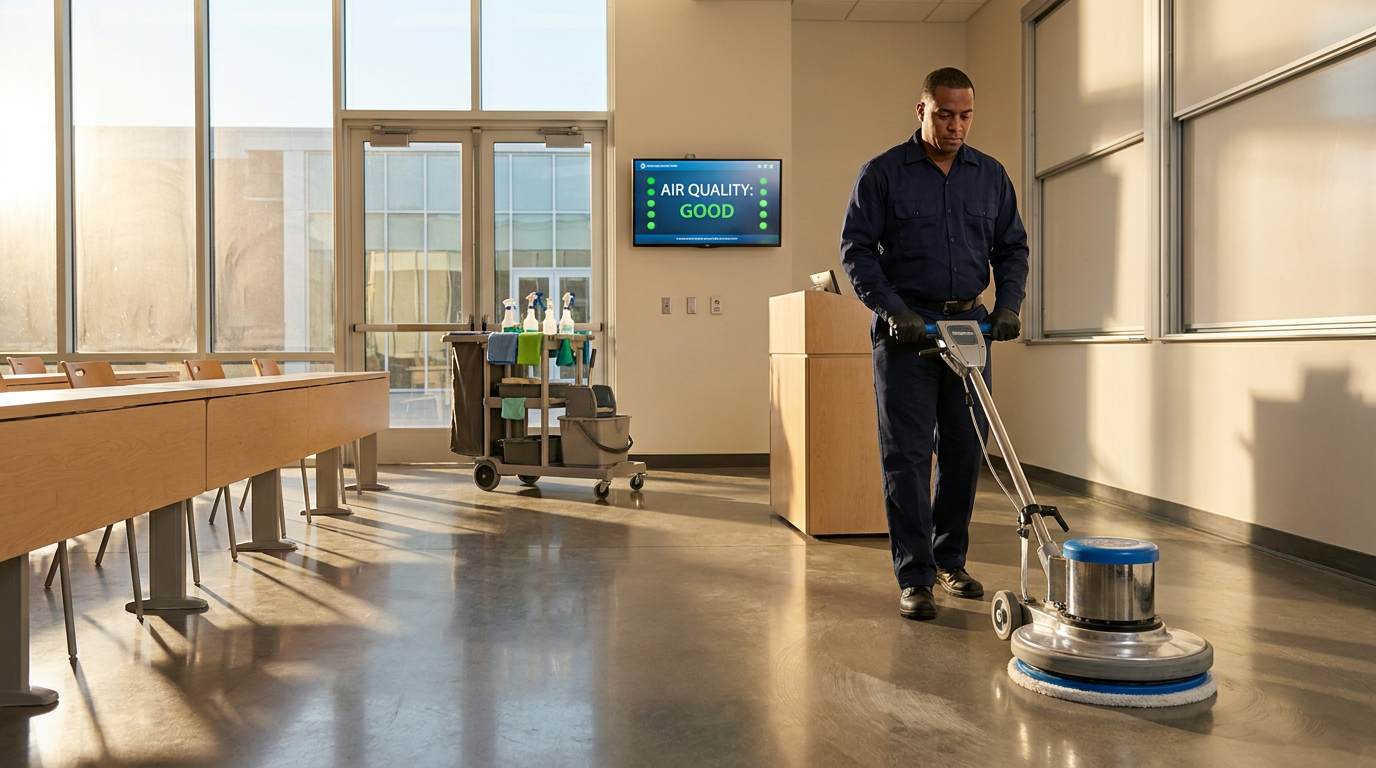
VCT floors in high-traffic school corridors need commercial floor stripping and waxing every 6 to 12 months. Schools with 500 or more students typically require the shorter interval due to accelerated wear patterns. Between full strip cycles, commercial floor scrubbing and waxing every 2 to 3 months maintains appearance and slip resistance.
University lobbies featuring marble or terrazzo require specialized care. These natural stone surfaces need professional marble and terrazzo polishing annually to maintain their appearance and prevent etching from foot traffic and spilled beverages.
Restroom Floor Maintenance Standards
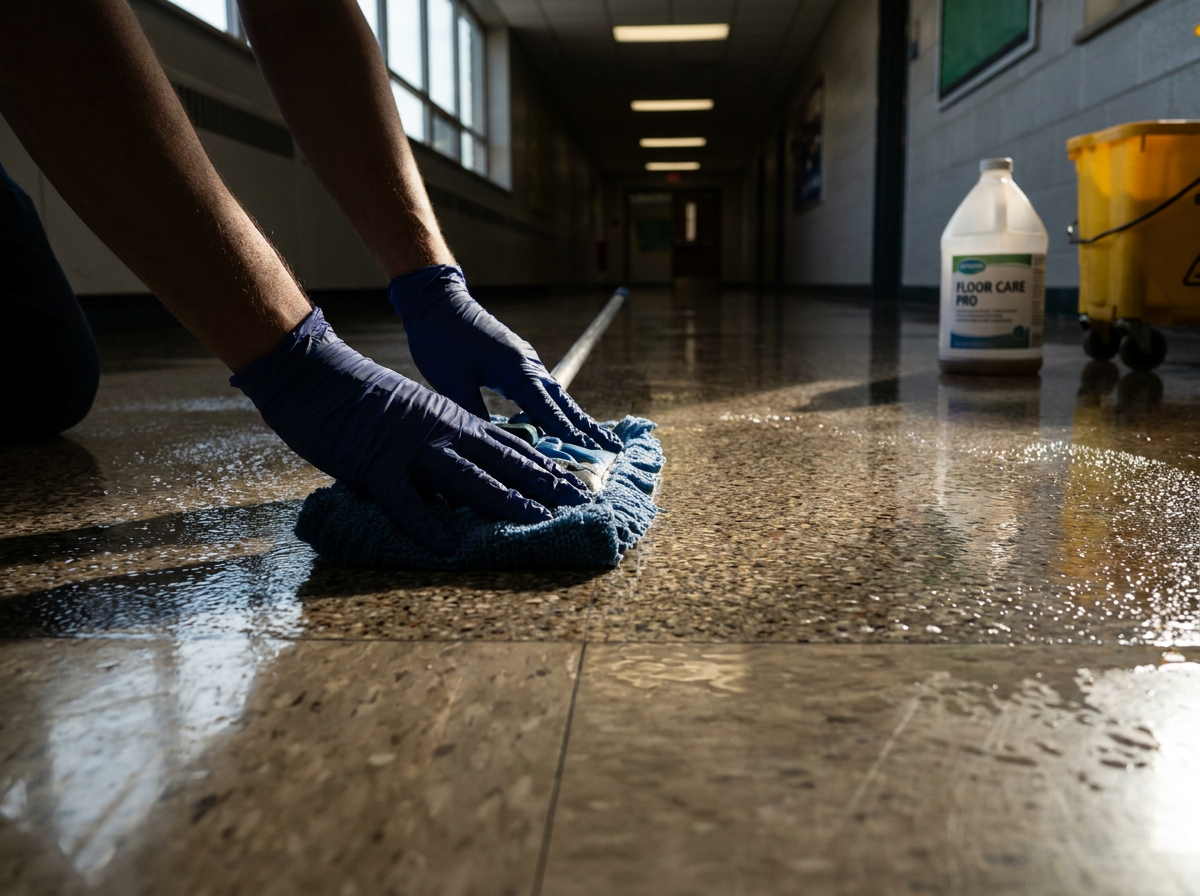
School restroom floors present unique challenges due to moisture exposure and biological contamination risks. The ISSA (International Sanitary Supply Association) recommends daily wet mopping with EPA-registered disinfectants and weekly deep cleaning with hot water extraction for grout lines.
Tile and grout in school restrooms accumulates bacteria in porous grout lines within 48 hours of cleaning. Professional commercial tile and grout cleaning quarterly prevents biofilm buildup that harbors pathogens like E. coli and norovirus.
Indoor Air Quality Compliance for Schools
Poor indoor air quality in schools correlates with 10% to 20% increases in student absenteeism, according to the EPA’s Indoor Air Quality Tools for Schools program. ASHRAE Standard 62.1 establishes minimum ventilation requirements of 10 CFM (cubic feet per minute) per person in classrooms.
HVAC systems in educational facilities require cleaning every 3 to 5 years under normal conditions. Schools in South Florida face accelerated timelines of 2 to 3 years due to humidity levels averaging 75% that promote microbial growth in ductwork. Professional commercial air duct cleaning removes dust, debris, and microbial buildup that compromises air quality.
Understanding commercial air duct cleaning costs helps facility managers budget appropriately. Schools under 5,000 square feet typically pay $300 to $500, while larger facilities exceeding 15,000 square feet range from $900 to $1,500.
Specialized Cleaning for Gymnasium and Athletic Facilities
Gymnasium floors require daily dust mopping and weekly damp mopping with pH-neutral cleaners. The Maple Flooring Manufacturers Association recommends humidity control between 35% and 50% for hardwood gymnasium floors to prevent warping and cupping.
Locker rooms and athletic training facilities present elevated infection risks. MRSA (Methicillin-resistant Staphylococcus aureus) outbreaks in school athletic programs increased 47% between 2019 and 2024, according to CDC surveillance data. These spaces require hospital-grade disinfection protocols similar to gym and fitness center cleaning services.
Cafeteria and Food Service Area Requirements
School cafeterias fall under FDA Food Code regulations enforced by local health departments. Florida requires food contact surfaces to be cleaned and sanitized every 4 hours during continuous use. Non-food contact surfaces like floors need cleaning after each meal service.
Cafeteria floors accumulate grease and food residue that creates slip hazards and attracts pests. Weekly deep cleaning with degreasing agents and monthly commercial floor deep cleaning maintains safety standards and passes health inspections.
Kitchen Hood and Exhaust Cleaning
NFPA 96 (National Fire Protection Association) mandates kitchen exhaust system cleaning based on cooking volume. School cafeterias cooking daily require quarterly hood cleaning. Documentation of cleaning dates must be maintained for fire marshal inspections.
Documentation and Compliance Tracking
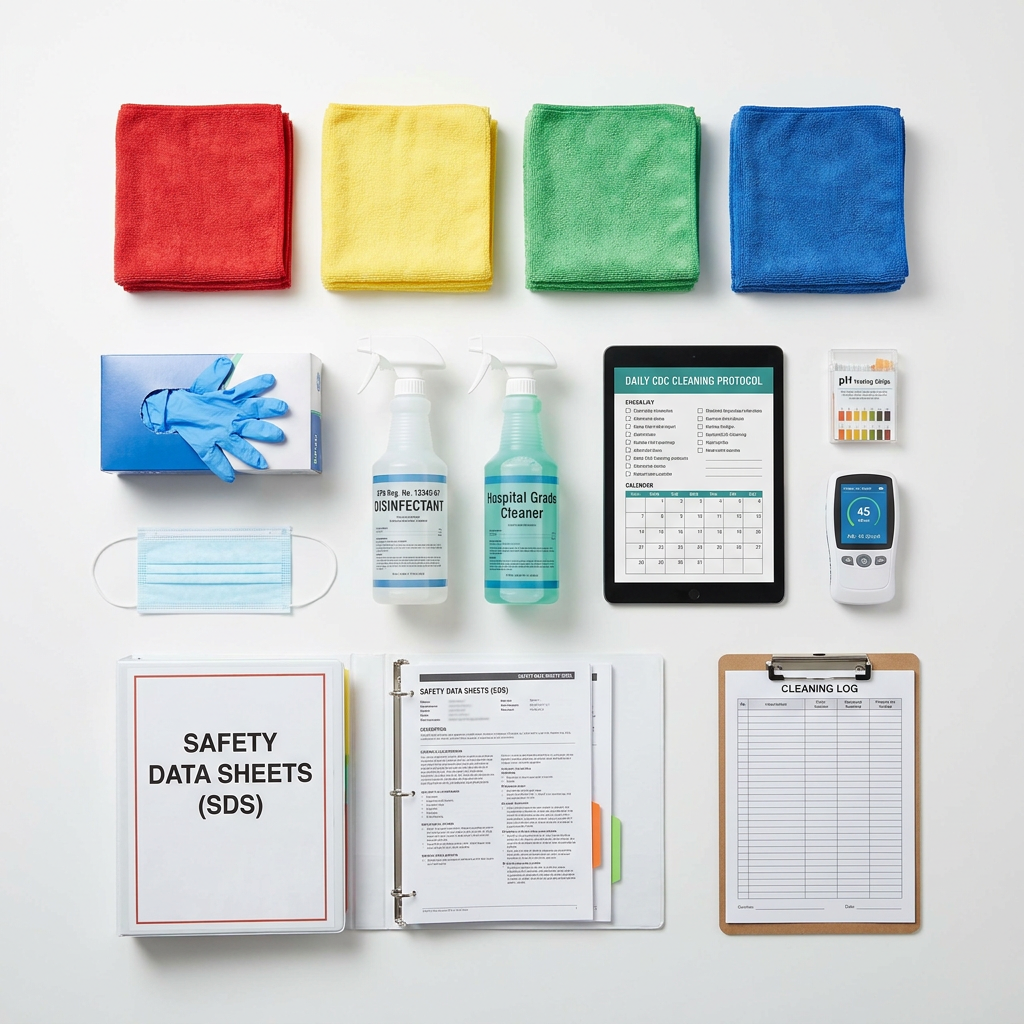
Florida school districts must maintain cleaning logs demonstrating compliance with state health standards. These records face review during annual health department inspections and can be requested during litigation related to illness outbreaks.
Effective documentation includes date and time of cleaning, surfaces cleaned, products used with EPA registration numbers, staff member signatures, and supervisor verification. Digital tracking systems like Cleantelligent, OrangeQC, and Swept provide audit trails that satisfy regulatory requirements.
According to industry research on school cleaning standards, facilities with documented cleaning protocols experience 35% fewer compliance violations during inspections compared to those relying on informal processes.
Green Cleaning Programs for Educational Facilities
The EPA’s Safer Choice program certifies cleaning products meeting environmental and health criteria suitable for schools. Green Seal GS-37 and GS-42 standards provide additional guidance for educational facility cleaning products.
Implementing green cleaning reduces student and staff exposure to volatile organic compounds (VOCs) that trigger asthma symptoms. Schools with comprehensive green cleaning programs report 20% to 30% reductions in asthma-related nurse visits, according to the Healthy Schools Campaign.
Low-odor chemistry proves especially important in educational settings where strong chemical smells distract students and trigger complaints. Professional cleaning services using low-odor products can complete work during evening hours without lingering odors affecting morning classes.
Seasonal Cleaning Considerations for South Florida Schools
South Florida’s climate creates unique challenges for educational facility maintenance. Hurricane season (June through November) requires pre-storm preparation and post-storm remediation protocols. The Millennium Facility Services risk guide for school cleaning emphasizes the importance of rapid response capabilities during weather events.
Summer humidity averaging 80% promotes mold growth in unoccupied classrooms. Schools should maintain HVAC operation at 78 degrees Fahrenheit during summer breaks rather than shutting systems down completely. This prevents mold colonization that requires expensive remediation before fall semester.
Back-to-school deep cleaning should begin 2 to 3 weeks before students return. This timeline allows for comprehensive commercial cleaning services including floor refinishing, carpet extraction, and HVAC maintenance without rushed schedules that compromise quality.
Selecting a Qualified Educational Facility Cleaning Provider
Schools should verify that cleaning contractors carry appropriate insurance coverage, including general liability of $1 million minimum and workers compensation. Certificates of Insurance (COI) should name the school district as additional insured.
Experience with educational facilities matters significantly. Contractors should demonstrate familiarity with FERPA (Family Educational Rights and Privacy Act) requirements that restrict access to student records and understanding of background check requirements for personnel working in schools.
Request references from similar educational clients and verify compliance history with the Florida Department of Health. Contractors should provide detailed scope of work documents specifying frequencies, products, and quality metrics.
Need Professional Cleaning for Your Educational Facility?
MB Floor Solutions LLC serves schools and universities across Miami-Dade, Broward, and Palm Beach Counties with compliant floor care, deep cleaning, and facility maintenance. Contact us at (954) 380-3050 for a free on-site assessment.
Get Your Free Assessment