Complete commercial floor maintenance checklist with daily, weekly, and monthly tasks. Includes VCT, tile, carpet, and stone care schedules for 2026.
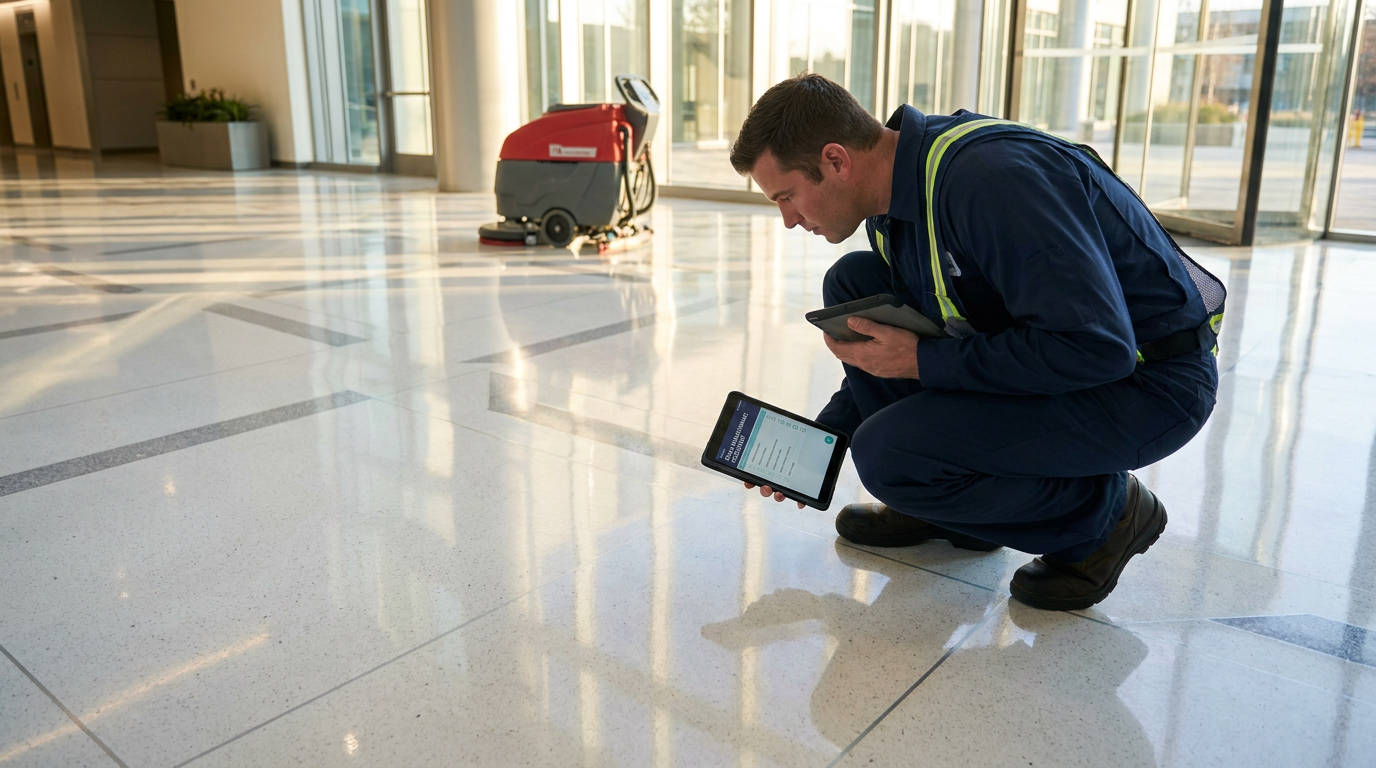
A commercial floor maintenance checklist organizes daily, weekly, monthly, and annual tasks by floor type to prevent premature wear, reduce replacement costs by 40 to 60 percent, and maintain safe, professional environments. This guide provides specific schedules, product recommendations, and service intervals for VCT, LVT, tile, carpet, marble, terrazzo, and concrete floors in commercial facilities.
- Daily tasks include dust mopping, spot cleaning spills within 5 minutes, and inspecting entrance mats to capture 80 percent of tracked soil
- VCT floors require scrub and recoat every 3 to 6 months and full strip and wax every 6 to 12 months
- Commercial carpet needs bonnet cleaning every 3 to 6 months in standard traffic; every 1 to 3 months in healthcare settings
- Marble and terrazzo floors require diamond honing and polishing every 6 to 12 months to maintain slip resistance and appearance
- Proper maintenance programs reduce total flooring lifecycle costs by 35 to 50 percent compared to reactive repair approaches
Why Facility Managers Need a Structured Floor Maintenance Checklist
Commercial floors represent 8 to 15 percent of a facility's total construction cost, according to data from the International Facility Management Association (IFMA). Without systematic maintenance, floor replacement cycles shorten from 15 to 20 years down to 7 to 10 years. A structured checklist prevents this accelerated deterioration.
The Occupational Safety and Health Administration (OSHA) reports that slips, trips, and falls account for 15 percent of all accidental workplace deaths. Proper floor maintenance directly addresses this liability by maintaining coefficient of friction levels above the 0.5 threshold recommended by the American National Standards Institute (ANSI).
Reactive maintenance costs 3 to 5 times more than preventive programs. Emergency floor repairs average $2.50 to $4.00 per square foot, while scheduled maintenance ranges from $0.35 to $1.50 per square foot depending on floor type and service frequency.
Daily Floor Maintenance Tasks
Daily maintenance prevents soil accumulation that damages floor finishes and creates slip hazards. These tasks take 15 to 30 minutes per 5,000 square feet when performed consistently.
Entrance and High Traffic Areas
Inspect and clean entrance mats every morning. According to the ROC Cleaning hard floor maintenance guide, properly maintained entrance matting systems capture 80 percent of tracked soil before it reaches interior floors. Replace saturated or damaged mats immediately.
Dust mop all hard surface floors using microfiber pads treated with dust mop treatment solution. Work from the perimeter toward the center, overlapping strokes by 2 to 3 inches. In South Florida facilities, high humidity requires dust mopping twice daily during summer months to prevent soil adhesion.
Spot Cleaning Protocol
Address spills within 5 minutes to prevent staining and slip hazards. Use pH-neutral cleaners diluted according to manufacturer specifications, typically 1 to 2 ounces per gallon of water. Place wet floor signs and allow 10 to 15 minutes of drying time before removing barriers.
Document all spill incidents in a maintenance log, including location, substance, response time, and resolution. This documentation supports liability protection and identifies problem areas requiring additional matting or traffic pattern changes.
Restroom Floor Inspection
Check restroom floors every 2 to 4 hours during business operations. Remove standing water near sinks and urinals. Spot mop with disinfectant solution containing quaternary ammonium compounds at 400 to 800 parts per million concentration.
Weekly Floor Maintenance Schedule
Weekly tasks address accumulated soil that daily maintenance cannot remove. Schedule these activities during low-traffic periods, typically after 6:00 PM or before 7:00 AM.
Wet Mopping Hard Floors
Wet mop all hard surface floors using a two-bucket system: one for clean solution, one for rinse water. Change solution every 500 to 800 square feet to prevent redepositing soil. Use auto-scrubbers for areas exceeding 3,000 square feet to improve efficiency by 60 to 70 percent.
For VCT and LVT floors, use cleaners with pH levels between 7.0 and 9.0. Acidic cleaners below pH 6.0 strip floor finish prematurely. Alkaline cleaners above pH 10.0 can damage resilient flooring adhesives.
Carpet Vacuuming Deep Pass
Perform slow-pass vacuuming at 1 foot per second, making 4 to 6 passes over high-traffic lanes. Commercial upright vacuums with HEPA filtration remove 99.97 percent of particles 0.3 microns and larger. Empty vacuum bags or canisters when 50 percent full to maintain suction efficiency.
Edge vacuuming along walls, under furniture, and around obstacles requires crevice tools and should occur weekly in all carpeted areas. Neglected edges accumulate soil that migrates into traffic lanes during foot traffic.
Grout Line Inspection
Inspect tile grout weekly for discoloration, cracking, or missing sections. Mark problem areas for monthly deep cleaning or quarterly restoration. Grout deterioration in restrooms and kitchens often indicates moisture intrusion requiring immediate attention.
Monthly Floor Maintenance Requirements
Monthly maintenance addresses wear patterns and prepares floors for quarterly professional services. These tasks typically require 2 to 4 hours per 10,000 square feet.
Burnishing VCT and LVT Floors
High-speed burnishing at 1,500 to 2,500 RPM restores gloss to floor finish without adding new coats. Use white or light tan pads for finished floors. Burnish weekly in high-traffic corridors, monthly in moderate-traffic areas.
Before burnishing, dust mop thoroughly and spot clean any sticky residues. Burnishing over soil embeds contaminants into the finish layer, creating permanent discoloration that only stripping can remove.
Carpet Spot Treatment Audit
Audit all carpet areas for spots and stains that daily cleaning missed. Treat protein-based stains with enzyme cleaners, oil-based stains with solvent spotters, and tannin stains with oxidizing agents. Document persistent stains for professional extraction treatment.
Traffic lane graying indicates soil below the carpet surface that vacuuming cannot reach. Schedule commercial carpet cleaning when traffic lanes show visible color difference from surrounding areas.
Stone Floor Inspection
Inspect marble, terrazzo, and granite floors for etching, scratches, and dull spots. Circle problem areas with painter's tape for professional attention. Stone floors in lobbies and corridors typically show wear patterns within 6 to 8 months of polishing.
Quarterly Professional Service Schedule
Quarterly services require professional equipment and trained technicians. Schedule these services 2 to 3 weeks in advance to ensure availability and minimize operational disruption.
Scrub and Recoat for Resilient Floors
Between full strip cycles, commercial floor scrubbing and waxing refreshes gloss and protection at $0.35 to $0.55 per square foot. This service removes the top 2 to 3 mils of worn finish and applies 1 to 2 fresh coats.
Scrub and recoat extends full strip cycles from every 6 months to every 12 to 18 months, reducing annual maintenance costs by 25 to 35 percent. Most offices and retail spaces benefit from quarterly scrub and recoat; healthcare facilities and high-traffic corridors may require monthly service.
Commercial Carpet Extraction
Low-moisture bonnet cleaning removes embedded soil from commercial carpet without extended dry times. Professional services include pre-vacuuming, spot treatment, bonnet agitation, fiber grooming, and air mover quick-dry. Typical dry time is 1 to 2 hours, allowing same-day return to service.
According to the Reliable Floor Care commercial guide, quarterly carpet cleaning maintains indoor air quality by removing allergens, bacteria, and volatile organic compounds trapped in carpet fibers.
Tile and Grout Deep Cleaning
Professional commercial tile and grout cleaning uses mechanical agitation and hot water extraction to remove embedded bacteria and biofilm from porous grout. Service costs range from $0.50 to $1.50 per square foot depending on soil level and grout condition.
Optional penetrating sealer application after cleaning slows re-soiling by 40 to 60 percent. Color sealing provides uniform grout appearance while adding protection. Areas are ready for light foot traffic within 2 to 4 hours of service completion.
Semi-Annual and Annual Service Requirements
These services address cumulative wear that quarterly maintenance cannot reverse. Budget $0.75 to $2.50 per square foot annually for professional floor care services.
Strip and Wax for VCT and LVT
Full commercial floor stripping and waxing removes all existing finish down to bare tile, then applies 3 to 5 fresh coats. This service costs $0.80 to $1.20 per square foot in South Florida, with high-rise buildings adding $0.15 to $0.25 per square foot for logistics.
Strip and wax requires 24 to 48 hours for complete curing before heavy traffic or furniture replacement. Schedule during holiday weekends or facility closures to minimize disruption. After-hours and weekend scheduling is available from professional contractors.
Marble and Terrazzo Restoration
Professional marble and terrazzo polishing uses progressive diamond honing from 220 to 800 grit to remove etches and fine scratches. Dust-controlled processes and slurry containment protect adjacent surfaces during restoration.
Lobby and corridor stone floors typically require restoration every 6 to 12 months. High-traffic entrances may need touch-up polishing every 3 to 6 months. Optional penetrating impregnating sealer provides 12 to 24 months of stain protection.
Concrete and Epoxy Floor Maintenance
Warehouse and industrial concrete floors require annual deep cleaning with auto-scrubbers using alkaline degreasers. Epoxy-coated floors need inspection for peeling, chipping, and chemical damage. Spot repairs cost $3 to $8 per square foot; full recoating costs $2 to $5 per square foot.
Floor Maintenance Frequency Comparison by Floor Type
| Floor Type | Daily Tasks | Weekly Tasks | Quarterly Service | Annual Service |
|---|---|---|---|---|
| VCT/LVT | Dust mop, spot clean | Wet mop, burnish high-traffic | Scrub and recoat | Strip and wax |
| Ceramic Tile | Dust mop, spot clean | Wet mop, inspect grout | Deep clean and seal | Grout restoration |
| Commercial Carpet | Vacuum traffic lanes, spot clean | Deep vacuum, edge work | Bonnet cleaning | Hot water extraction |
| Marble/Terrazzo | Dust mop, neutral cleaner | Damp mop, inspect for etching | Touch-up polishing | Diamond honing and polish |
| Concrete/Epoxy | Sweep, spot clean spills | Auto-scrub high-traffic | Degreaser treatment | Seal or recoat |
Industry-Specific Floor Maintenance Considerations
Different facility types require modified maintenance schedules based on regulatory requirements, traffic patterns, and contamination risks.
Healthcare Facilities
Healthcare floors require daily disinfection using EPA-registered hospital-grade disinfectants. The Centers for Disease Control and Prevention (CDC) recommends contact times of 1 to 10 minutes depending on the disinfectant formulation. Floor finish must maintain slip resistance while allowing effective disinfection.
Strip and wax cycles in healthcare settings typically occur every 4 to 6 months due to aggressive cleaning chemicals that break down floor finish faster than standard commercial environments. Low-odor chemistry and after-hours scheduling minimize patient and staff disruption.
Retail and Office Buildings
Retail floors experience 500 to 2,000 foot-traffic passes daily in high-volume locations. Entrance areas require 15 to 20 feet of walk-off matting to capture soil before it reaches sales floors. The FMX facilities management checklist recommends daily entrance mat inspection as a critical maintenance task.
Office buildings with standard 8:00 AM to 6:00 PM operations benefit from after-hours cleaning between 6:00 PM and 6:00 AM. This scheduling allows wet floors to dry completely before morning occupancy, reducing slip hazards and improving finish cure times.
Food Service and Restaurant Facilities
Kitchen floors require daily degreaser treatment and weekly deep cleaning to meet health department standards. Florida Department of Business and Professional Regulation (DBPR) inspections evaluate floor cleanliness, grout condition, and slip resistance as critical compliance factors.
Quarry tile and non-slip ceramic in commercial kitchens need specialized cleaning equipment that can handle grease accumulation without damaging textured surfaces. Professional services use rotary floor machines with aggressive brush attachments and hot water extraction.
Educational Facilities
Schools and universities face unique challenges including summer deep cleaning windows, high-traffic corridors during class changes, and budget constraints. According to the school and university facility cleaning compliance guide, Florida educational facilities must meet specific cleaning standards for state funding eligibility.
Summer break provides 8 to 12 weeks for comprehensive floor restoration including strip and wax, carpet extraction, and tile restoration. Planning should begin in March or April to secure contractor availability during peak summer demand.
Equipment and Supply Inventory Checklist
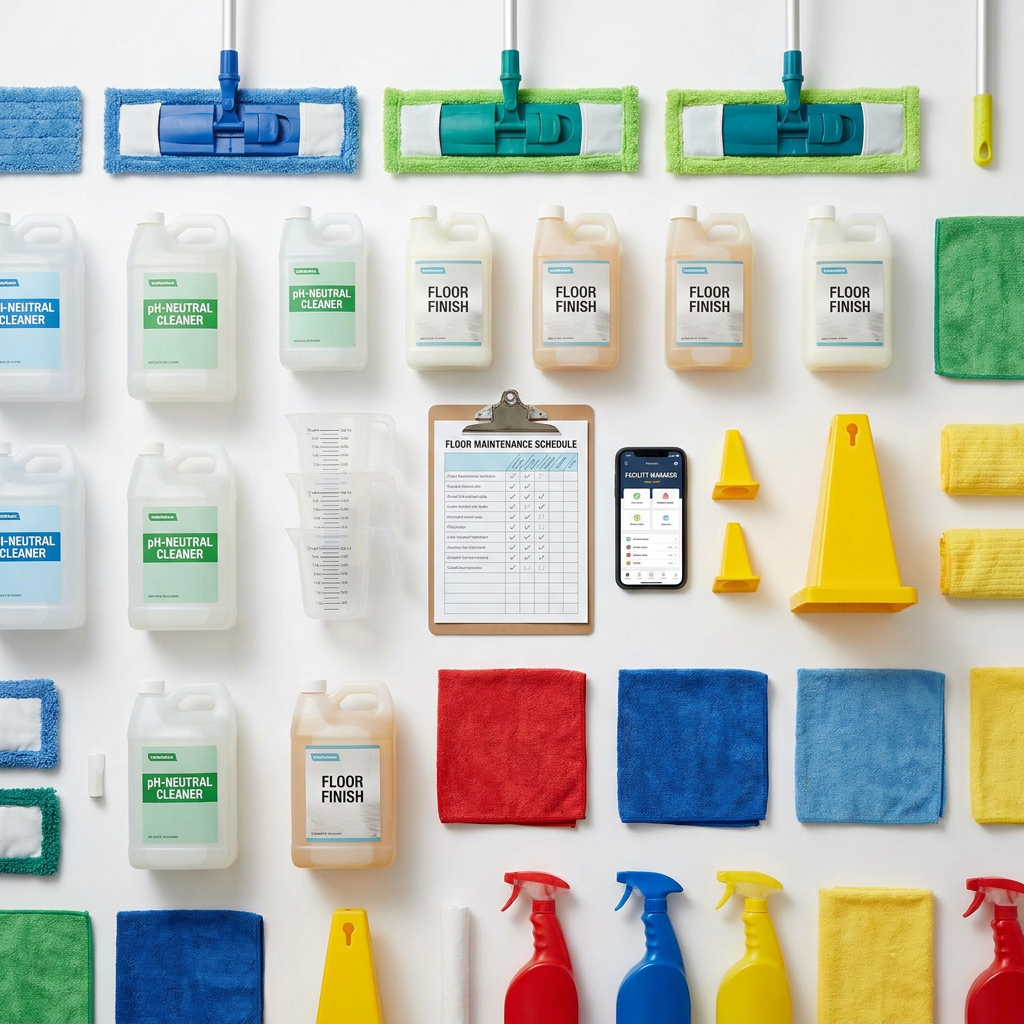
Maintaining proper equipment and supplies prevents maintenance delays and ensures consistent results. Audit inventory monthly and reorder when supplies reach 25 percent of normal stock levels.
Daily Maintenance Supplies
Stock microfiber dust mop heads (minimum 6 per 10,000 square feet), dust mop treatment solution, pH-neutral floor cleaner concentrate, spray bottles, wet floor signs, and microfiber wet mop pads. Replace microfiber pads after 300 to 500 wash cycles or when they no longer absorb effectively.
Weekly and Monthly Equipment
Maintain auto-scrubbers with daily squeegee inspection, weekly brush/pad replacement assessment, and monthly battery maintenance. High-speed burnishers require pad changes every 20 to 40 hours of operation. HEPA vacuum filters need replacement every 3 to 6 months depending on soil load.
Professional Service Equipment
Verify that contracted service providers use commercial-grade equipment including low-RPM floor machines for stripping (175 to 350 RPM), high-speed burnishers (1,500 to 2,500 RPM), auto-scrubbers with solution recovery, and high-velocity air movers for quick dry times.
Documentation and Compliance Tracking
Proper documentation supports warranty claims, liability protection, and budget justification. Digital tracking systems improve accuracy and accessibility compared to paper logs.
Daily Log Requirements
Record date, time, areas cleaned, products used, equipment deployed, and technician name for each daily maintenance session. Note any damage, spills, or unusual conditions observed during cleaning. This documentation supports slip-and-fall defense and identifies recurring problem areas.
Service History Tracking
Maintain records of all professional services including date, contractor name, areas serviced, products applied, and before/after photos. Request Certificates of Insurance (COI) annually from all floor care contractors. Verify coverage includes general liability of $1 million or more and workers' compensation.
For comprehensive guidance on selecting and vetting commercial cleaning contractors, review the commercial cleaning insurance requirements checklist which details coverage verification procedures.
Budget and Cost Tracking
Track maintenance costs per square foot monthly to identify trends and justify budget requests. Compare actual costs against industry benchmarks: $0.15 to $0.25 per square foot monthly for standard office maintenance, $0.25 to $0.40 for healthcare facilities, and $0.20 to $0.35 for retail environments.
Seasonal Maintenance Adjustments for South Florida
South Florida's subtropical climate creates unique floor maintenance challenges including high humidity, hurricane season preparation, and increased soil tracking during rainy months.
Summer Humidity Management
Relative humidity above 60 percent slows floor finish drying times and promotes mold growth in grout lines. Schedule strip and wax services during morning hours when HVAC systems have reduced interior humidity. Allow 48 to 72 hours for complete cure during summer months versus 24 to 48 hours in winter.
Increase dust mopping frequency to twice daily during summer when humidity causes soil to adhere more aggressively to floor surfaces. The summer cleaning challenges guide provides detailed protocols for managing humidity-related floor maintenance issues.
Hurricane Season Preparation
Before hurricane season (June through November), complete all pending floor restoration projects. Post-storm flooding requires immediate water extraction within 24 to 48 hours to prevent permanent damage to VCT adhesives and subfloor materials. Maintain emergency contact information for floor care contractors offering 24/7 response.
Rainy Season Protocols
May through October brings daily afternoon thunderstorms that track significant soil and moisture into facilities. Double entrance matting during rainy season and increase mat cleaning frequency to twice daily. Consider temporary walk-off runners in high-traffic corridors during active weather events.
Implementing Your Floor Maintenance Program
Successful floor maintenance programs combine in-house daily tasks with scheduled professional services. Start by auditing current floor conditions, identifying problem areas, and establishing baseline documentation.
Create a 12-month calendar scheduling all quarterly and annual services at least 90 days in advance. Communicate schedules to building occupants and coordinate with other facility maintenance activities to minimize cumulative disruption.
Review and adjust your maintenance program annually based on documented results, budget performance, and changing facility needs. Floors that receive consistent preventive maintenance maintain appearance and safety for 15 to 20 years, while neglected floors require replacement in 7 to 10 years.
For facilities requiring professional floor maintenance services in Miami-Dade, Broward, or Palm Beach Counties, contact MB Floor Solutions for a free on-site assessment and written quote. Their team provides custom floor maintenance programs tailored to each facility's specific floor types, traffic patterns, and operational schedules.
Get Your Custom Floor Maintenance Program
MB Floor Solutions provides free on-site assessments for commercial facilities throughout South Florida. Receive a detailed maintenance plan with transparent pricing for your specific floor types and facility needs.
Schedule Your Free Assessment