Complete guide to healthcare facility cleaning standards covering OSHA bloodborne pathogen rules, CDC disinfection protocols, EPA requirements, and compliance documentation.
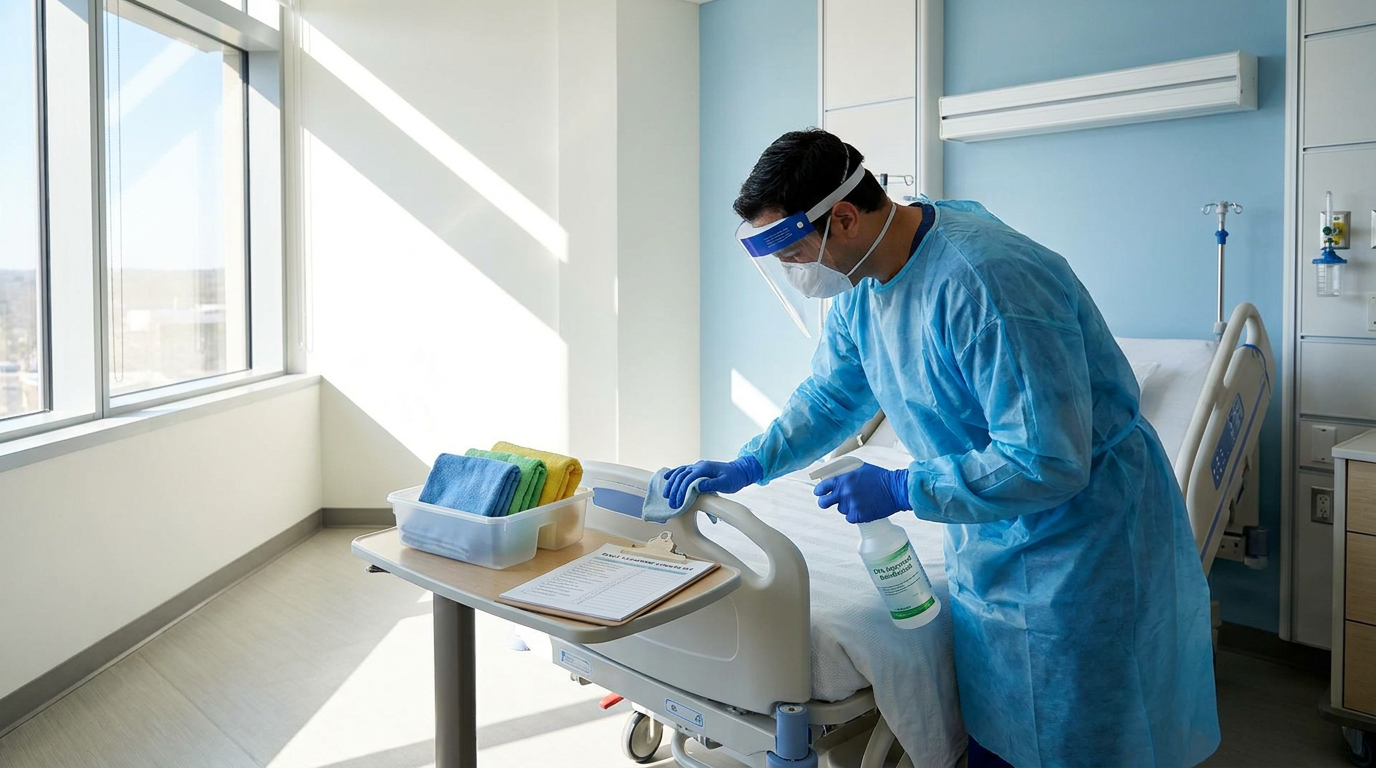
Healthcare facility cleaning standards require compliance with three overlapping regulatory frameworks: OSHA's Bloodborne Pathogens Standard (29 CFR 1910.1030), CDC infection control guidelines, and EPA-registered disinfectant requirements. Facilities that fail any of these face fines ranging from $15,625 to $156,259 per violation, plus increased healthcare-associated infection (HAI) rates that affect approximately 1 in 31 hospital patients daily.
- OSHA mandates written Exposure Control Plans, annual bloodborne pathogen training, and proper PPE for all staff handling contaminated materials
- CDC guidelines require cleaning before disinfection, with high-touch surfaces cleaned every 2-4 hours in patient care areas
- EPA-registered disinfectants must achieve the exact contact time listed on labels, typically 1-10 minutes for healthcare use
- Documentation of training, cleaning schedules, and product usage is required for Joint Commission and CMS compliance
- Terminal cleaning after patient discharge requires 15-25 specific touchpoints depending on room classification
Understanding the Three-Agency Regulatory Framework
Healthcare cleaning compliance involves distinct but interconnected requirements from OSHA, CDC, and EPA. Each agency governs different aspects of the cleaning process, and understanding their jurisdictions prevents compliance gaps that inspectors frequently cite.
OSHA regulates worker safety during cleaning operations. The agency's Bloodborne Pathogens Standard requires facilities to protect Environmental Services (EVS) staff from exposure to blood and other potentially infectious materials (OPIM). This includes mandatory hepatitis B vaccinations offered at no cost, proper sharps disposal, and engineering controls that minimize exposure risk.
CDC provides evidence-based infection control guidance through its Guidelines for Environmental Infection Control in Healthcare Facilities. While CDC guidelines are technically recommendations rather than regulations, CMS and Joint Commission surveyors treat them as de facto standards. Facilities that deviate from CDC guidance must document equivalent or superior alternative methods.
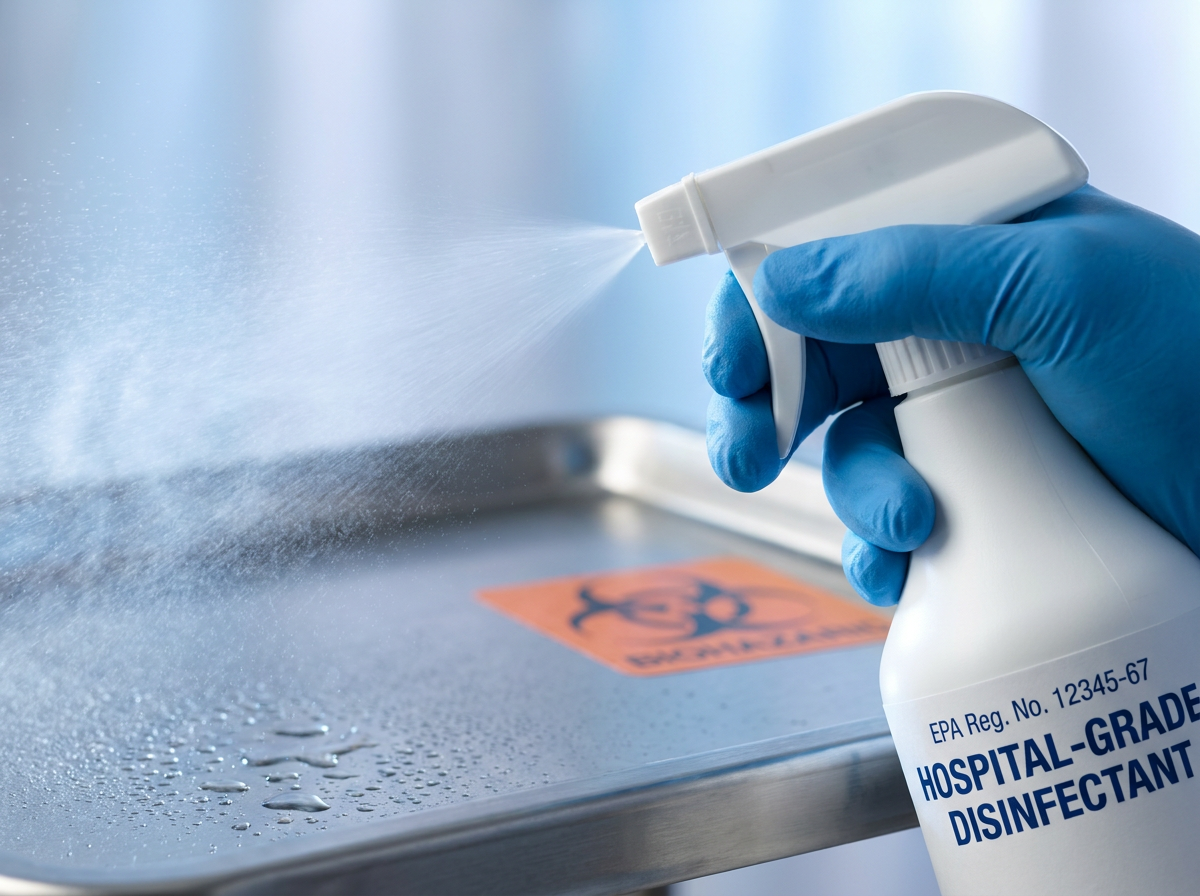
EPA registers and regulates the disinfectants used in healthcare settings. Every product must carry an EPA registration number, and facilities must follow label instructions exactly. Using a product at dilutions or contact times different from the label violates federal law under FIFRA (Federal Insecticide, Fungicide, and Rodenticide Act).
OSHA Bloodborne Pathogens Compliance Requirements
OSHA's Bloodborne Pathogens Standard applies to all employees with reasonably anticipated occupational exposure to blood or OPIM. For healthcare EVS staff, this includes routine cleaning of patient rooms, procedure areas, and any space where blood exposure may occur.
Written Exposure Control Plan
Every healthcare facility must maintain a written Exposure Control Plan (ECP) that identifies job classifications with exposure risk, describes protective measures, and outlines post-exposure procedures. OSHA requires annual review and updates whenever new tasks, procedures, or positions create additional exposure situations.
The ECP must include: exposure determination by job title and task, schedule for implementing engineering and work practice controls, PPE requirements by task, hepatitis B vaccination program details, post-exposure evaluation procedures, and training documentation requirements.
Training and Documentation
Initial bloodborne pathogen training must occur before employees perform tasks with exposure risk. Annual refresher training is mandatory, not optional. Training records must include dates, content summaries, trainer qualifications, and attendee names. OSHA requires retention of these records for 3 years beyond the employee's last day of employment.
Training content must cover: epidemiology and symptoms of bloodborne diseases, modes of transmission, the facility's ECP location and contents, recognition of exposure-prone tasks, proper PPE selection and use, decontamination procedures, and emergency contact information for exposure incidents.
CDC Infection Control Cleaning Protocols
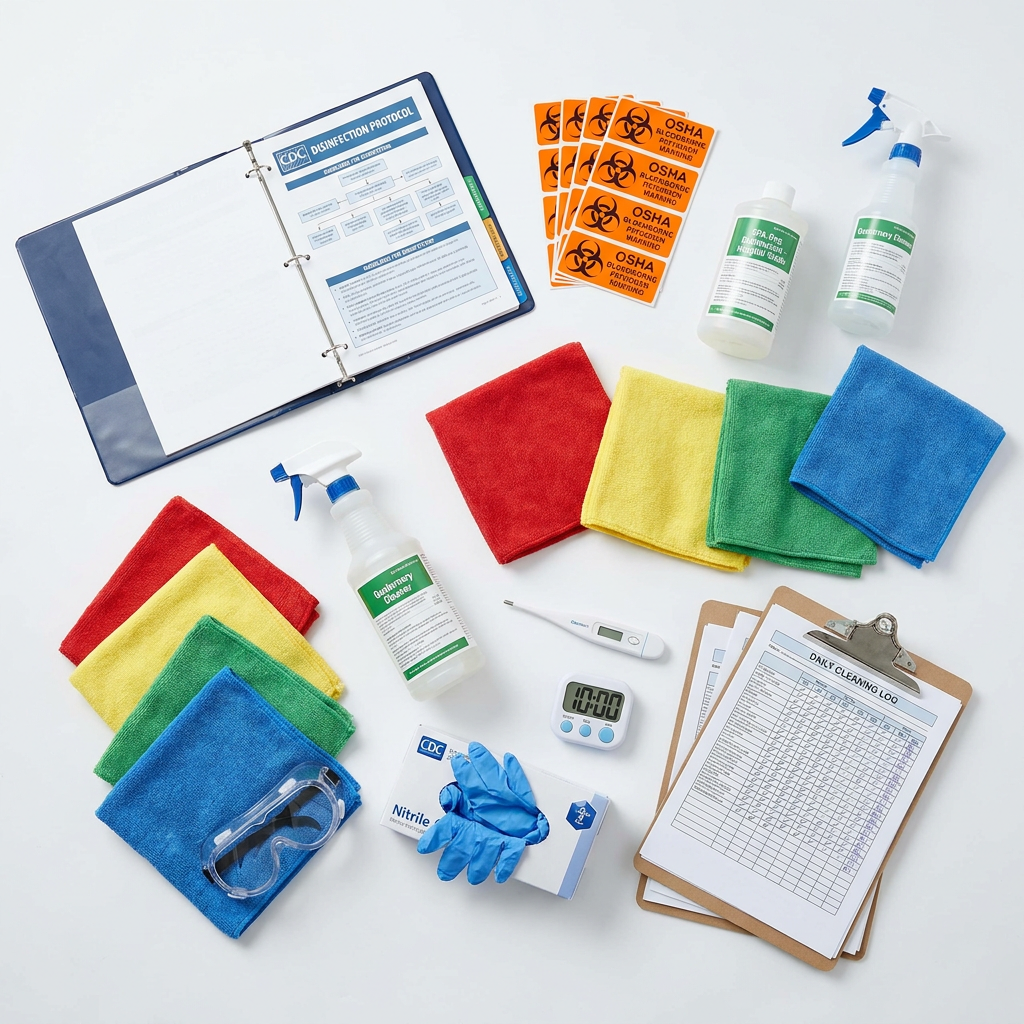
CDC's environmental infection control guidelines establish cleaning frequencies, methods, and verification procedures based on room risk classification. The 2024 updates emphasize enhanced cleaning during respiratory illness outbreaks and expanded high-touch surface protocols.
Risk-Based Cleaning Frequencies
| Area Classification | Routine Cleaning | High-Touch Surfaces | Terminal Cleaning |
|---|---|---|---|
| Operating Rooms | Between cases | Every procedure | Daily after last case |
| Isolation Rooms | Daily minimum | Every 2-4 hours | At discharge plus hold time |
| Patient Rooms | Daily | Every 4-8 hours | At discharge |
| Public Areas/Lobbies | 2-3 times daily | Every 4 hours | N/A |
| Administrative Offices | Daily | Daily | N/A |
The Two-Step Cleaning Process
CDC guidelines mandate cleaning before disinfection. This sequence matters because organic matter (blood, body fluids, soil) inactivates most disinfectants. Applying disinfectant to visibly soiled surfaces wastes product and fails to achieve pathogen kill.
Step one involves removing visible soil using detergent and mechanical action. Step two applies EPA-registered disinfectant to the cleaned surface, allowing full contact time before wiping or allowing to air dry. Skipping step one is the most common compliance failure identified during infection control surveys.
High-Touch Surface Protocol
High-touch surfaces require more frequent attention than general environmental surfaces. CDC identifies these as surfaces touched multiple times daily by multiple people. In patient rooms, this includes bed rails, call buttons, bedside tables, door handles, light switches, IV poles, and bathroom fixtures.
Studies published in the American Journal of Infection Control show that high-touch surfaces in patient rooms harbor 3-10 times more pathogens than low-touch surfaces. Facilities implementing enhanced high-touch protocols report 20-30% reductions in HAI rates within 6-12 months.
EPA Disinfectant Requirements and Contact Time Compliance
EPA registration ensures disinfectants meet efficacy claims against specific pathogens. Healthcare facilities must use products registered for healthcare or hospital use, with claims against relevant organisms including MRSA, VRE, C. difficile, and bloodborne pathogens.
Contact Time: The Most Violated Requirement
Contact time, also called wet contact time or dwell time, refers to how long a surface must remain wet with disinfectant to achieve the kill claims on the label. This ranges from 1 minute for some quaternary ammonium products to 10 minutes for certain sporicidal agents effective against C. difficile.
Compliance surveys consistently find contact time violations in 40-60% of observed cleaning events. Staff often wipe surfaces immediately after applying disinfectant, negating its effectiveness. Training must emphasize that a surface wiped after 30 seconds when the label requires 3 minutes provides minimal pathogen reduction.
Product Selection by Pathogen
Not all EPA-registered disinfectants kill all pathogens. Facilities must match products to infection control risks. Standard quaternary ammonium compounds work for most bacteria and enveloped viruses. C. difficile requires sporicidal products, typically bleach-based solutions at 5,000 ppm concentration with 10-minute contact time.
The EPA maintains List N for products effective against emerging pathogens and List K for products with claims against C. difficile spores. Infection preventionists should verify that EVS products appear on relevant EPA lists for the facility's pathogen concerns.
Terminal Cleaning and Discharge Protocols
Terminal cleaning occurs after patient discharge and involves comprehensive room decontamination. This process differs significantly from daily maintenance cleaning in scope, time requirements, and verification methods.
Standard Terminal Cleaning Checklist
A complete terminal clean addresses 15-25 touchpoints depending on room type and equipment present. Core elements include: bed frame and mattress, all bed linens replaced, bedside table and overbed table, call light and cord, television remote, telephone, door handles (both sides), light switches, thermostat, window sills, chairs, IV poles, medical equipment surfaces, bathroom fixtures, toilet, and floor.
For isolation rooms, terminal cleaning expands to include walls to hand height, cubicle curtain replacement, and potentially enhanced disinfection using UV-C light or hydrogen peroxide vapor systems. According to research from the Association for Professionals in Infection Control and Epidemiology (APIC), UV-C adjunct disinfection reduces subsequent patient infection risk by 10-30% compared to manual cleaning alone.
Verification Methods
Visual inspection alone misses 40-50% of cleaning deficiencies. Evidence-based verification methods include fluorescent marker systems, ATP bioluminescence testing, and direct observation audits.
Fluorescent markers involve applying invisible gel to high-touch surfaces before cleaning. Post-cleaning UV light inspection reveals whether surfaces were actually wiped. ATP testing measures organic material remaining on surfaces, with readings below 250-500 RLU (relative light units) indicating adequate cleaning depending on the testing system used.
Training Requirements for Healthcare EVS Staff
Effective healthcare cleaning standards require comprehensive training beyond basic janitorial skills. Staff must understand infection transmission, proper chemical handling, PPE selection, and documentation requirements.
Core Competencies
Healthcare EVS training must cover: infection transmission modes, hand hygiene (WHO 5 Moments framework), PPE donning and doffing sequences, chemical safety and SDS interpretation, cleaning sequence (clean to dirty, top to bottom), disinfectant contact time requirements, isolation precaution categories, sharps safety, and spill response procedures.
Competency verification should occur at hire, annually, and whenever procedures change. Documentation must include training dates, topics covered, competency demonstration methods, and trainer credentials. Joint Commission surveyors frequently request EVS training records during accreditation surveys.
Specialized Training for High-Risk Areas
Operating rooms, procedure suites, and isolation rooms require additional training beyond standard patient room protocols. OR cleaning staff must understand traffic patterns, sterile field concepts, and between-case versus terminal cleaning distinctions. Isolation room cleaners need pathogen-specific precaution training and proper PPE sequences for contact, droplet, and airborne isolation categories.
Documentation and Compliance Recordkeeping
Healthcare facility cleaning documentation serves multiple purposes: demonstrating regulatory compliance, supporting quality improvement, and providing legal protection. Incomplete records create presumptions of non-compliance during surveys and litigation.
Required Documentation Categories
Facilities must maintain: training records (initial and annual), cleaning schedules and completion logs, product inventory with SDS sheets, equipment maintenance records, quality audit results, incident reports for exposures or spills, and corrective action documentation for identified deficiencies.
Electronic systems increasingly replace paper logs, offering advantages in searchability, timestamp verification, and trend analysis. However, electronic systems must include audit trails showing who entered data and when, preventing after-the-fact modifications that undermine record integrity.
Common Compliance Failures and How to Avoid Them
Survey data from CMS and Joint Commission identifies recurring compliance gaps. Addressing these proactively prevents citations and, more importantly, reduces infection risk.
Inadequate contact time: Staff wipe disinfectant before required dwell time. Solution: Use products with shorter contact times (1-3 minutes) or train staff on spray-and-walk-away techniques for appropriate surfaces.
Missing training documentation: Records exist but lack required elements. Solution: Use standardized training checklists that capture all required data points including trainer credentials and competency verification methods.
Inconsistent high-touch cleaning: Some surfaces cleaned, others missed. Solution: Implement room-specific checklists and fluorescent marker verification programs.
Improper dilution: Concentrated products mixed incorrectly. Solution: Use pre-measured packets or automated dilution systems that eliminate guesswork.
Cross-contamination: Same cloths used across rooms or clean/dirty areas. Solution: Color-coded microfiber systems with single-use protocols per room.
Selecting a Compliant Healthcare Cleaning Partner
Healthcare facilities increasingly outsource EVS functions to specialized contractors. Selecting a compliant partner requires verification of training programs, insurance coverage, and healthcare-specific experience.
Key evaluation criteria include: documented bloodborne pathogen training programs, healthcare facility references, appropriate insurance coverage including professional liability, familiarity with Joint Commission and CMS requirements, quality assurance programs with measurable outcomes, and willingness to participate in facility infection control committees.
Facilities in South Florida requiring compliant healthcare cleaning services should verify that contractors maintain current training certifications and can provide documentation meeting regulatory requirements. Services like cubicle curtain cleaning and maintenance and stretcher and wheelchair sanitization require healthcare-specific protocols that general janitorial contractors may lack.
Frequently Asked Questions
What are OSHA requirements for cleaning medical offices?
OSHA requires medical offices to maintain written Exposure Control Plans, provide annual bloodborne pathogen training to staff with exposure risk, offer hepatitis B vaccinations at no cost, supply appropriate PPE, and maintain training and exposure incident records for 3 years beyond employment termination.
What does the CDC require for healthcare facility disinfection?
CDC requires a two-step process: cleaning to remove visible soil followed by disinfection with EPA-registered products. High-touch surfaces need cleaning every 2-8 hours depending on area risk classification. Terminal cleaning after patient discharge must address all touchpoints using pathogen-appropriate disinfectants with proper contact times.
What disinfectants are approved for healthcare cleaning?
EPA-registered hospital-grade disinfectants with claims against relevant pathogens are required. Products must appear on EPA List N for emerging pathogens or List K for C. difficile when those organisms are concerns. Label contact times must be followed exactly.
How often should high-touch surfaces be cleaned in a clinic?
High-touch surfaces in patient care areas require cleaning every 2-4 hours during occupied periods. Waiting rooms and public areas need high-touch cleaning every 4 hours. Administrative areas require daily high-touch surface attention.
What training do janitorial staff need for healthcare cleaning?
Healthcare EVS staff need bloodborne pathogen training (initial and annual), chemical safety training, PPE competency verification, infection control basics including transmission modes and hand hygiene, and area-specific training for high-risk spaces like operating rooms and isolation rooms.
Do healthcare cleaning vendors need bloodborne pathogen training?
Yes. Any worker with reasonably anticipated occupational exposure to blood or OPIM must receive bloodborne pathogen training regardless of employment status. Contract EVS staff have identical training requirements to facility employees under OSHA regulations.
Need Compliant Healthcare Facility Cleaning in South Florida?
MB Floor Solutions LLC provides healthcare-specialized cleaning services across Miami-Dade, Broward, and Palm Beach Counties. Our trained teams understand OSHA, CDC, and EPA requirements for medical facilities.
Request a Free Assessment