Learn how HVAC systems affect indoor air quality in commercial buildings. Covers filtration, ventilation, maintenance schedules, and IAQ improvement strategies.

HVAC systems control 40 to 60 percent of indoor air quality in commercial buildings through four mechanisms: ventilation rates, filtration efficiency, humidity regulation, and component cleanliness. A properly maintained system with MERV 13 filters removes 85 to 95 percent of airborne particles, while a neglected system with clogged filters and contaminated ducts can degrade IAQ by 40 to 60 percent and spread pollutants throughout the building.
- MERV 13 filters reduce airborne particle concentrations by 30 to 70 percent compared to MERV 8 filters
- ASHRAE Standard 62.1 sets minimum outdoor air ventilation rates for commercial occupancies
- Optimal relative humidity ranges from 40 to 60 percent to prevent mold growth and respiratory issues
- Annual duct cleaning removes 3 to 5 pounds of debris per 1,000 square feet and improves airflow efficiency by 25 to 40 percent
- HVAC systems account for approximately 39 percent of total building energy use
Four Pathways HVAC Systems Use to Control Indoor Air Quality
Commercial HVAC systems influence indoor air quality through ventilation, filtration, humidity control, and system cleanliness. According to Canada's federal workplace HVAC guidance, these systems maintain thermal comfort while ensuring IAQ through outdoor air introduction and proper maintenance protocols.
Each pathway operates independently but creates compounding effects. A system with excellent filtration but poor ventilation still accumulates CO2 and volatile organic compounds. Conversely, high ventilation rates cannot compensate for contaminated ductwork that reintroduces pollutants with every air cycle.
Ventilation and Outdoor Air Supply
Outdoor air dilutes indoor pollutants including carbon dioxide, VOCs, odors, and bioaerosols. ASHRAE Standard 62.1 establishes minimum outdoor air ventilation rates for commercial occupancies, typically ranging from 5 to 20 cubic feet per minute per person depending on space type and occupancy density.
Insufficient ventilation causes CO2 levels to exceed 1,000 parts per million, triggering occupant complaints about stale air, headaches, and difficulty concentrating. Many IAQ problems trace back to dampers or air handling controls that no longer modulate correctly, reducing outdoor air intake below design specifications.
Modern commercial buildings increasingly use CO2 based demand controlled ventilation to adjust outdoor air based on real time occupancy. This approach reduces IAQ complaints while cutting energy costs by 10 to 30 percent compared to constant volume systems.
Filtration and Particle Removal
Central HVAC filters capture dust, pollen, mold spores, and respiratory aerosols based on their Minimum Efficiency Reporting Value rating. According to research on MERV 13 and UV-C tradeoffs in office HVAC systems, upgrading from MERV 8 to MERV 13 filters reduces steady state airborne particle concentrations by 30 to 70 percent.
ASHRAE 62.1 and current best practice call for MERV 13 or higher in many commercial occupancies to capture fine particulates including PM2.5. Healthcare facilities, schools, and high density offices benefit most from this upgrade, though increased filter resistance requires verification that existing fan systems can maintain adequate airflow.
| MERV Rating | Particle Size Captured | Typical Applications | Replacement Frequency |
|---|---|---|---|
| MERV 8 | 3.0 to 10.0 microns | Standard commercial, warehouses | Every 90 days |
| MERV 11 | 1.0 to 3.0 microns | Offices, retail spaces | Every 60 to 90 days |
| MERV 13 | 0.3 to 1.0 microns | Healthcare, schools, high density offices | Every 30 to 60 days |
| MERV 16 | Less than 0.3 microns | Hospitals, cleanrooms, laboratories | Every 30 days |
Humidity Control and Microbial Growth Prevention
Relative humidity between 40 and 60 percent represents the optimal range for occupant comfort and IAQ. Below 40 percent, occupants experience dry eyes, respiratory irritation, and increased susceptibility to airborne pathogens. Above 60 percent, mold growth accelerates and dust mites thrive.
South Florida's humid subtropical climate creates particular challenges for commercial buildings. Cooling coils, condensate pans, and drain lines accumulate moisture that supports mold and biofilm formation when not properly maintained. Once established, these biological contaminants become persistent IAQ sources that require professional remediation.
How Poor HVAC Maintenance Degrades Indoor Air Quality
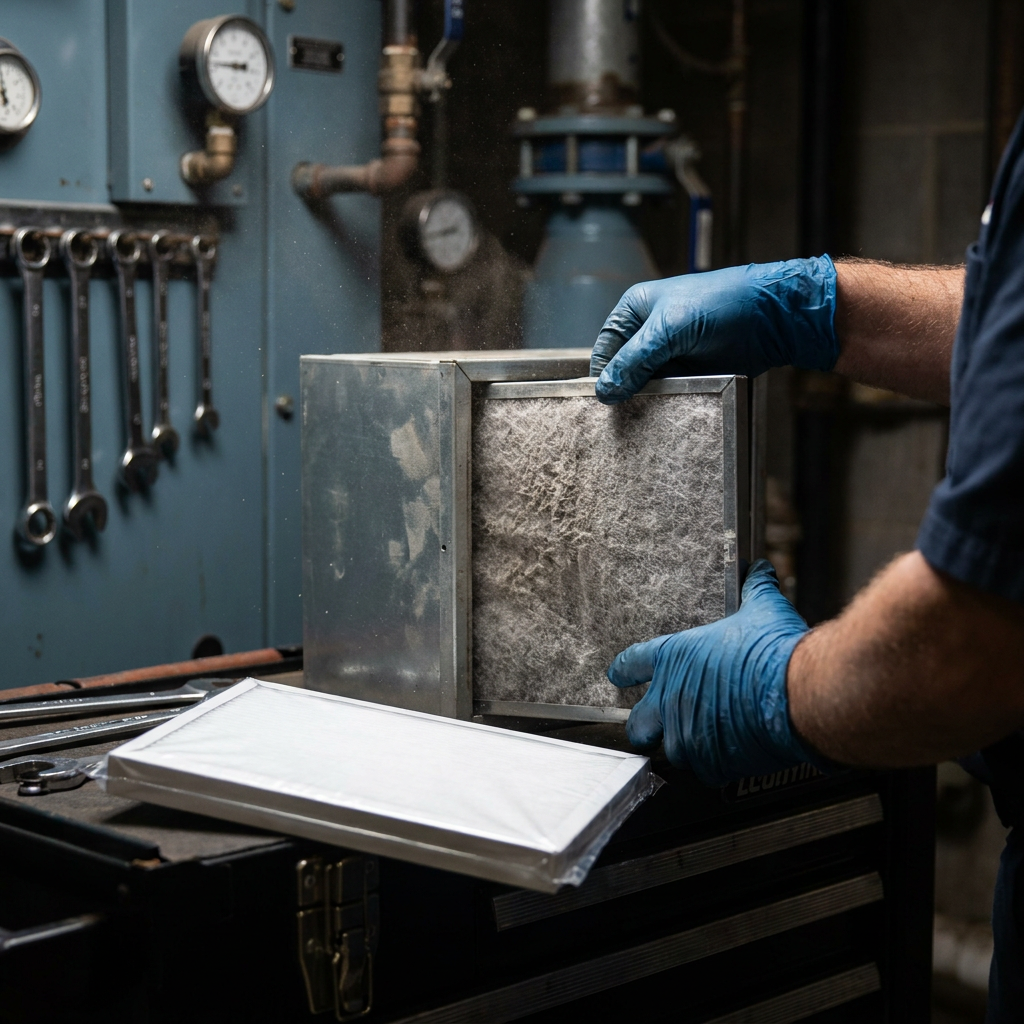
Neglected HVAC systems transform from air quality assets into pollutant distribution networks. According to Airmid Health Group's IAQ guide, poorly maintained systems contribute to dust buildup and biological contamination that spreads throughout the building with every air cycle.
Ductwork Contamination and Pollutant Distribution
Commercial ductwork accumulates dust, debris, pest residue, and microbial growth over time. Annual commercial air duct cleaning typically removes 3 to 5 pounds of debris per 1,000 square feet and improves airflow efficiency by 25 to 40 percent.
Contaminated ducts create two problems simultaneously. First, they reintroduce settled pollutants into the breathing zone every time the system operates. Second, debris accumulation increases static pressure, forcing fans to work harder while delivering less airflow to occupied spaces.
Healthcare facilities, restaurants, and manufacturing spaces face elevated duct contamination risks due to grease, biological materials, and process byproducts. The commercial air duct cleaning cost guide details pricing by facility type and square footage for South Florida buildings.
Filter Loading and Performance Degradation
Clogged filters reduce particle capture efficiency while increasing system energy consumption. A filter loaded to 80 percent capacity may capture only 40 to 50 percent of particles it would remove when clean, while creating 2 to 3 times the pressure drop across the filter bank.
Filter replacement schedules vary by MERV rating, local air quality, and building use. Miami and South Florida facilities typically require more frequent changes due to high outdoor pollen counts, humidity, and construction activity. Most commercial facilities should inspect filters monthly and replace them every 30 to 90 days based on loading.
Control System Drift and Ventilation Faults
Building automation systems experience gradual performance drift that reduces ventilation effectiveness. Sensors lose calibration, damper actuators stick, and control sequences get overridden during troubleshooting and never restored. These faults often go undetected for months or years.
Common ventilation faults include outdoor air dampers stuck at minimum position, economizer controls disabled, and CO2 sensors reading artificially low values. Each fault reduces outdoor air delivery below ASHRAE 62.1 minimums while the building appears to operate normally.
HVAC Maintenance Practices That Protect Indoor Air Quality
Proactive maintenance transforms HVAC systems into reliable IAQ assets rather than liability sources. The following schedule represents best practices for commercial facilities in South Florida's demanding climate.
Monthly Maintenance Tasks
Monthly inspections catch problems before they affect occupant comfort or health. Facility managers should verify filter condition, check condensate drain flow, inspect visible ductwork for leaks or damage, and review building automation system trends for anomalies.
Filter inspection requires removing at least one filter from each air handler to assess loading visually. Filters showing visible gray discoloration or reduced light transmission when held to a light source need replacement regardless of scheduled change date.
Quarterly Maintenance Tasks
Quarterly maintenance addresses components that degrade more slowly but significantly impact IAQ. Coil cleaning removes biofilm and debris that reduce heat transfer and harbor microbial growth. Damper operation testing confirms outdoor air delivery meets design specifications.
CO2 sensor calibration ensures demand controlled ventilation responds accurately to occupancy changes. Sensors drift 50 to 100 parts per million annually, potentially causing under ventilation in occupied spaces or energy waste in empty areas.
Annual Maintenance Tasks
Annual maintenance includes comprehensive duct inspection and cleaning, fan belt replacement, motor lubrication, and full control system commissioning verification. Professional air duct and AC vent cleaning using truck mounted equipment removes accumulated contamination that monthly filter changes cannot address.
Duct cleaning costs range from $300 to $500 for facilities under 5,000 square feet, $500 to $900 for 5,000 to 15,000 square feet, and $900 to $1,500 for facilities exceeding 15,000 square feet. Specialized facilities including hospitals and manufacturing plants typically require $1,500 to $3,000 or more due to additional access challenges and contamination types.
| Maintenance Task | Frequency | IAQ Impact | Typical Cost |
|---|---|---|---|
| Filter replacement | Every 30 to 90 days | Maintains 85 to 95 percent particle removal | $15 to $75 per filter |
| Coil cleaning | Quarterly | Prevents biofilm and mold growth | $150 to $400 per unit |
| Duct cleaning | Annually | Removes 3 to 5 lbs debris per 1,000 sq ft | $300 to $3,000 by facility size |
| Sensor calibration | Quarterly | Ensures accurate ventilation control | $75 to $200 per sensor |
| Damper testing | Quarterly | Verifies outdoor air delivery | $100 to $300 per air handler |
Technologies That Improve Commercial Building IAQ
Beyond basic maintenance, several technologies enhance HVAC system IAQ performance. Selection depends on building type, occupancy patterns, budget constraints, and specific IAQ concerns.
Energy Recovery Ventilators
Energy recovery ventilators exchange heat and moisture between exhaust and outdoor air streams, allowing higher ventilation rates without proportional energy penalties. ERVs typically recover 60 to 80 percent of the energy that would otherwise be lost, reducing the cost of conditioning outdoor air by a similar percentage.
ERV integration makes sense for buildings in extreme climates or those requiring high outdoor air fractions. South Florida facilities benefit particularly during summer months when outdoor air at 90 degrees and 80 percent relative humidity must be cooled and dehumidified before distribution.
UV-C Germicidal Systems
Ultraviolet germicidal irradiation systems installed on cooling coils reduce biological growth and help maintain heat transfer efficiency. UV-C wavelengths between 254 and 265 nanometers damage microbial DNA, preventing reproduction without introducing chemicals into the airstream.
Coil mounted UV-C systems operate continuously and require lamp replacement every 12 to 18 months at costs ranging from $100 to $300 per lamp. When combined with proper filtration, these systems support lower bioaerosol levels and reduce coil cleaning frequency.
Real Time IAQ Monitoring
Modern IAQ monitoring systems track CO2, PM2.5, total volatile organic compounds, temperature, and humidity continuously. According to Milesight's IAQ and HVAC control research, real time monitoring enables proactive HVAC adjustments and verifies system performance against design specifications.
Sensor networks cost $200 to $500 per monitoring point plus $50 to $150 monthly for cloud based data analysis platforms. Return on investment comes from reduced occupant complaints, documented IAQ compliance, and early detection of ventilation faults before they cause health impacts.
Signs Your Commercial HVAC System Is Degrading Indoor Air Quality
Facility managers should watch for warning signs that indicate HVAC related IAQ problems requiring professional assessment and remediation.
Occupant Symptoms and Complaints
Headaches, fatigue, difficulty concentrating, and respiratory irritation that improve when occupants leave the building suggest IAQ problems. Symptoms concentrated in specific zones often indicate local ventilation deficiencies or contamination sources.
Odor complaints provide valuable diagnostic information. Musty smells suggest mold growth in ducts or condensate systems. Chemical odors may indicate VOC sources or inadequate exhaust from copy rooms, kitchens, or storage areas.
Physical Indicators
Visible dust accumulation on supply diffusers indicates filter bypass or duct contamination. Condensation on windows or walls suggests humidity control problems that promote mold growth. Inconsistent temperatures between zones may reflect airflow imbalances that also affect ventilation distribution.
The five signs your Miami office needs deep cleaning guide covers additional physical indicators that suggest professional assessment is warranted.

Frequently Asked Questions
How do commercial HVAC systems improve or worsen indoor air quality?
Commercial HVAC systems improve IAQ through filtration that removes 85 to 95 percent of airborne particles, ventilation that dilutes indoor pollutants with outdoor air, and humidity control that maintains 40 to 60 percent relative humidity. Systems worsen IAQ when filters clog, reducing particle capture to 40 to 50 percent; when ducts accumulate contamination that spreads with each air cycle; or when controls malfunction, reducing outdoor air delivery below ASHRAE 62.1 minimums.
What role does filter MERV rating play in indoor air quality for office buildings?
MERV rating determines what particle sizes a filter captures efficiently. MERV 8 filters capture particles 3.0 microns and larger, suitable for basic dust control. MERV 13 filters capture particles down to 0.3 microns, including PM2.5 and many respiratory aerosols. Upgrading from MERV 8 to MERV 13 reduces airborne particle concentrations by 30 to 70 percent in typical office environments.
How often should HVAC filters and ducts be cleaned to maintain healthy IAQ?
Filters require inspection monthly and replacement every 30 to 90 days depending on MERV rating, local air quality, and building use. MERV 13 filters in high occupancy spaces may need replacement every 30 to 60 days. Ductwork requires professional cleaning annually, which removes 3 to 5 pounds of accumulated debris per 1,000 square feet and improves airflow efficiency by 25 to 40 percent.
What indoor air quality standards apply to commercial buildings?
ASHRAE Standard 62.1 establishes minimum outdoor air ventilation rates for commercial occupancies, typically 5 to 20 cubic feet per minute per person. The standard also specifies filtration requirements and design guidance for IAQ. Local building codes may adopt ASHRAE 62.1 by reference or establish additional requirements for specific building types including healthcare facilities and schools.
Can upgrading to MERV 13 filters and adding ERVs significantly reduce airborne pollutants?
Yes. MERV 13 filters reduce airborne particle concentrations by 30 to 70 percent compared to MERV 8 filters. Energy recovery ventilators allow 60 to 80 percent higher ventilation rates without proportional energy penalties, further diluting indoor pollutants. Combined, these upgrades can reduce occupant exposure to airborne particles and bioaerosols by 50 to 80 percent in typical commercial buildings.
How does demand controlled ventilation using CO2 sensors affect IAQ and energy use?
Demand controlled ventilation adjusts outdoor air delivery based on real time occupancy measured by CO2 sensors. This approach increases ventilation during peak occupancy to maintain IAQ while reducing outdoor air during low occupancy periods. Facilities typically achieve 10 to 30 percent energy savings compared to constant volume systems while maintaining or improving IAQ during occupied hours.
What are the signs that an HVAC system is causing poor indoor air quality?
Warning signs include occupant complaints of headaches, fatigue, and respiratory irritation that improve outside the building; musty or chemical odors near supply diffusers; visible dust accumulation on vents and surfaces; condensation on windows or walls; and inconsistent temperatures between zones. CO2 levels exceeding 1,000 parts per million indicate inadequate ventilation.
Improve Your Building's Indoor Air Quality
MB Floor Solutions provides professional commercial air duct cleaning services across Miami-Dade, Broward, and Palm Beach Counties. Our truck mounted equipment removes accumulated debris and contaminants that compromise indoor air quality in offices, healthcare facilities, and commercial buildings.
Request a Free Estimate