Learn how to choose a commercial cleaning service for your office building. Compare costs, evaluate vendors, and get pricing from $0.17 to $0.28 per sq ft.
The right commercial cleaning service for an office building costs between $0.17 and $0.28 per square foot monthly for janitorial services with 5x weekly frequency. Selection depends on building size, tenant requirements, cleaning frequency, security protocols, and whether you need specialty services like floor care or HVAC maintenance. Most facility managers should compare 3 to 4 vendors using standardized scope documents before signing any contract.
- Office cleaning costs range from $600 to $1,200 monthly for small offices (under 5,000 sq ft) and $3,000 to $8,000 monthly for large facilities
- Require minimum $2M general liability insurance and workers' compensation coverage from any vendor
- A 1,000 square foot office takes 45 to 90 minutes to clean depending on layout and task frequency
- Request 3 to 5 references from similar office buildings before signing any contract
- Use a 30-day trial period to evaluate quality, punctuality, and communication before committing long-term
Office Cleaning vs. Commercial Cleaning: Understanding the Difference
Office cleaning is a subset of commercial cleaning that focuses specifically on workspace environments. According to the International Sanitary Supply Association (ISSA), commercial cleaning encompasses all non-residential cleaning services, including industrial facilities, healthcare settings, retail spaces, and office buildings. Office cleaning targets the unique needs of professional workspaces: cubicle areas, conference rooms, executive offices, reception areas, and shared amenities like break rooms and restrooms.
The distinction matters when evaluating vendors. A company experienced in warehouse cleaning may lack expertise in the detailed work required for executive suites or multi-tenant office buildings. The Building Owners and Managers Association (BOMA) International recommends selecting vendors with documented experience in your specific building class, whether Class A downtown towers or suburban office parks.
Office buildings present unique challenges that general commercial cleaners may not anticipate. These include after-hours access coordination, tenant-specific cleaning requirements, elevator scheduling for equipment transport, and maintaining consistent service across multiple floors with different occupancy patterns.
Commercial Cleaning Rates: What Office Buildings Pay in 2026
According to industry data from Janitorial Leads Pro, the average commercial cleaning cost is $0.17 per square foot or $25 per hour per worker for basic janitorial services. However, office building rates vary significantly based on service frequency, building complexity, and regional labor costs. In South Florida markets like Miami-Dade, Broward, and Palm Beach Counties, rates typically run 10% to 15% higher than national averages due to labor market conditions.
| Office Size | Square Footage | Monthly Cost Range | Per Sq Ft Rate |
|---|---|---|---|
| Small Office | Under 5,000 sq ft | $600 to $1,200 | $0.12 to $0.24 |
| Medium Office | 5,000 to 20,000 sq ft | $1,200 to $3,000 | $0.15 to $0.24 |
| Large Facility | 20,000 to 50,000 sq ft | $3,000 to $8,000 | $0.15 to $0.20 |
| Enterprise Building | 50,000+ sq ft | $8,000 to $20,000+ | $0.16 to $0.28 |
These rates assume standard janitorial services with 5x weekly frequency. Specialty services like commercial floor stripping and waxing are typically priced separately at $0.80 to $1.20 per square foot depending on floor type and condition. Understanding the South Florida commercial cleaning cost comparison helps facility managers budget accurately for their specific market.
How Long Does It Take to Clean a 1,000 Square Foot Office?
A professional cleaning crew takes 45 to 90 minutes to clean a 1,000 square foot office, according to cleaning industry productivity standards published by CMM (Cleaning and Maintenance Management) magazine. The variance depends on office layout, furniture density, restroom count, and task scope. Open floor plans clean faster than offices with multiple private rooms requiring individual attention.
The ISSA Cleaning Times database, used by professional estimators, breaks down productivity rates by task. Vacuuming takes approximately 30 minutes per 1,000 square feet. Restroom cleaning averages 8 to 12 minutes per fixture. Trash removal and liner replacement requires 2 to 3 minutes per receptacle. These benchmarks help facility managers evaluate whether vendor quotes include adequate labor hours.
For larger office buildings, cleaning productivity improves with scale. A 10,000 square foot office does not require 10x the time of a 1,000 square foot space. Economies of scale reduce per-square-foot cleaning time by 15% to 25% in buildings over 5,000 square feet, assuming consistent layout and accessibility.
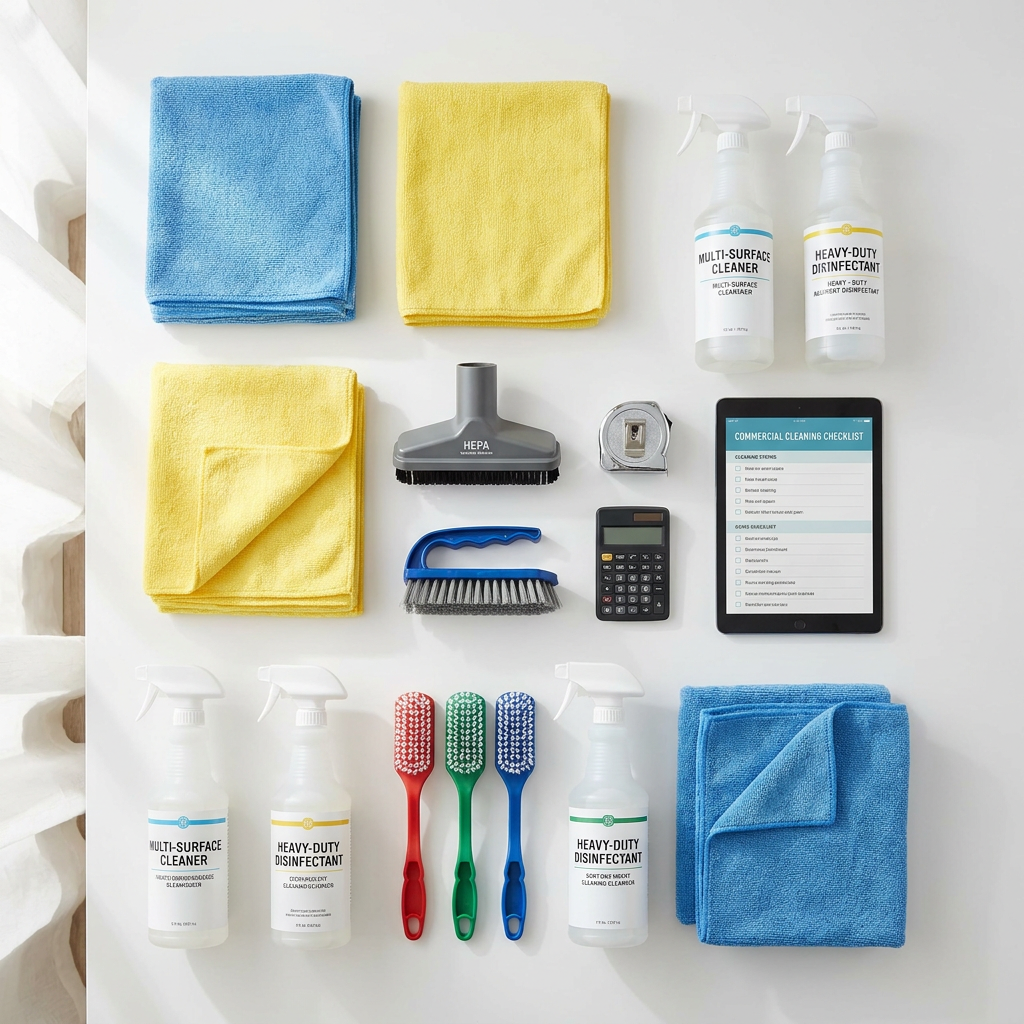
Essential Criteria for Evaluating Commercial Cleaning Vendors
Experience with Similar Office Buildings
Prioritize vendors that already clean office buildings matching your profile in square footage, tenant count, occupancy levels, and operating hours. A company servicing 150+ businesses across 1 million square feet of commercial space demonstrates operational capacity. Ask specifically about multi-tenant buildings, after-hours access protocols, and experience with your building class.
The Facilities Management Journal recommends requesting case studies or portfolio examples from prospective vendors. Look for documented experience with conference rooms, executive suites, shared kitchens, elevator lobbies, and restroom facilities. These high-touch areas require consistent attention that general cleaning crews may overlook.
Insurance and Risk Management Requirements
A qualified commercial cleaning vendor must provide current certificates for general liability insurance (minimum $2M to $5M for larger facilities), workers' compensation coverage for all employees, and bonding when handling sensitive areas. Request a Certificate of Insurance (COI) naming your business or property management company as an additional insured party.
According to the Insurance Information Institute, inadequate vendor insurance exposes building owners to significant liability. If an uninsured or underinsured cleaning worker is injured on your property, your building's insurance may become the primary payer. Verify coverage is current and adequate before any work begins.
Detailed Scope of Work Documentation
The proposal must specify exactly what gets cleaned, how often each task is performed, who supplies consumables (paper products, soap, liners), what is excluded from standard service, and escalation procedures for special requests. Vague proposals lead to disputes and unmet expectations.
A comprehensive scope document from a professional vendor includes task frequency matrices showing daily, weekly, monthly, and quarterly activities. It identifies quality control methods such as supervisor walkthroughs, inspection checklists, and corrective action procedures. This documentation becomes the performance standard against which you evaluate ongoing service.
Transparent Pricing Structure
Request written quotes using one of these standard pricing models: per square foot monthly rate, flat monthly fee, labor-based hourly estimate, or task-based pricing for specialty items. For office buildings, per-square-foot pricing combined with a detailed scope document provides the clearest basis for vendor comparison.
Watch for hidden costs that inflate the apparent low bid. Common add-ons include supply fees, equipment charges, holiday premiums, and extra charges for special cleaning requests. A transparent vendor includes all recurring costs in the base proposal and clearly identifies any potential additional charges.
Staff Screening, Training, and Supervision Standards
Office buildings require cleaning staff who can work around sensitive documents, expensive equipment, and confidential information. Ask prospective vendors about employee background check procedures, drug screening policies, training standards for new hires, staff turnover rates, onsite supervision protocols, and coverage procedures for absences.
The American Institute of Cleaning Sciences (AICS) certifies cleaning technicians through standardized training programs. Vendors employing AICS-certified staff or equivalent training demonstrate commitment to professional standards. High turnover rates (above 100% annually, common in the industry) indicate potential service inconsistency.
Supervision matters significantly for office building cleaning. Ask whether a supervisor inspects completed work, how often inspections occur, and how issues are documented and resolved. Companies using digital inspection systems with photo documentation provide better accountability than those relying on verbal reports.
Response Time and Account Management
Define acceptable response times before signing any contract. For office buildings, a 4-hour response window for standard issues and 2-hour response for urgent problems represents a practical benchmark. The contract should identify your dedicated account manager, establish communication protocols, and specify how complaints are logged and tracked.
Emergency escalation procedures matter for unexpected situations: spills in common areas, restroom emergencies, or last-minute cleaning needs before important meetings. Professional vendors maintain on-call supervisors and backup crews to handle urgent requests without disrupting scheduled service.
Green Cleaning and Sustainability Practices
Many office buildings, particularly Class A properties, now require green cleaning practices. The U.S. Green Building Council's LEED certification program includes credits for sustainable cleaning programs. Even buildings not pursuing LEED certification benefit from reduced chemical exposure and improved indoor air quality.
Look for vendors using products certified by Green Seal, EcoLogo, or EPA Safer Choice. These certifications verify reduced environmental impact without sacrificing cleaning effectiveness. Additional sustainable practices include microfiber cleaning systems (which reduce chemical and water use by up to 95%), HEPA-filtered vacuums, and recycling programs for cleaning containers.
Low-VOC (volatile organic compound) products matter especially in office environments where employees spend 8+ hours daily. According to the EPA, indoor air quality can be 2 to 5 times worse than outdoor air, partly due to cleaning chemical residues. Green cleaning programs address this concern while supporting corporate sustainability goals.
Step-by-Step Vendor Selection Process
Step 1: Build a Qualified Short List
Identify 3 to 4 vendors with documented office building experience in your market. Avoid making decisions based on a single walkthrough and verbal promises. Sources for qualified vendors include property management referrals, BOMA chapter member directories, and recommendations from similar buildings in your area.
Step 2: Standardize the Scope for Fair Comparison
Send each vendor identical information: building size and layout, cleaning frequency requirements, special areas (server rooms, executive floors, medical suites), access rules and security protocols, supply responsibilities, and service-level expectations. Without standardized scope documents, you cannot compare proposals meaningfully.
Step 3: Evaluate Proposals Beyond Price
A lower price often hides reduced service. Common cost-cutting tactics include fewer visits than competitors, reduced task frequency (weekly restroom deep cleaning vs. daily), weaker supervision, inadequate labor allocation, and extra fees for supplies or special cleaning. Score proposals on scope completeness, not just bottom-line price.
Step 4: Verify References Thoroughly
Request 3 to 5 references from similar office buildings and actually contact them. Ask specific questions: Was service consistent month to month? How quickly were issues resolved? Did staffing remain stable? Were inspections performed regularly? Did the company stay within contract terms? Reference checks reveal operational reality that proposals cannot show.
Step 5: Implement a Trial Period
A 30-day trial period tests quality, punctuality, communication, responsiveness, and consistency across shifts. This approach proves especially valuable when transitioning from an incumbent provider or moving from in-house cleaning to an outsourced vendor. Include trial period terms in your initial agreement with clear performance benchmarks.
Vendor Comparison Scorecard
Use weighted criteria to prevent over-emphasizing price at the expense of quality and reliability. This scorecard framework, adapted from IFMA (International Facility Management Association) best practices, provides structured evaluation.
| Evaluation Criteria | Weight | What to Verify |
|---|---|---|
| Office Building Experience | 20% | Similar building references, years in market, portfolio size |
| Scope Clarity and Detail | 20% | Task frequency matrix, inclusions/exclusions, quality control methods |
| Price Competitiveness | 15% | Total cost including supplies, no hidden fees, value alignment |
| Insurance and Compliance | 15% | Current COI, adequate limits, workers' comp, bonding if required |
| Staff Screening and Training | 10% | Background checks, certifications, turnover rate, training programs |
| Response Time and Support | 10% | Defined SLAs, account manager assignment, escalation procedures |
| Reference Quality | 5% | Similar buildings, verifiable contacts, positive feedback |
| Green Cleaning Practices | 5% | Certified products, sustainable methods, documentation |
Office Cleaning Duties: What Should Be Included
A comprehensive commercial cleaning services contract for office buildings includes both daily tasks and periodic deep cleaning activities. Understanding standard inclusions helps you evaluate whether proposals provide adequate coverage.
Daily Cleaning Tasks
Standard daily service includes trash removal and liner replacement, restroom cleaning and restocking, break room and kitchen surface sanitization, entrance and lobby maintenance, elevator cab cleaning, and general dusting of accessible surfaces. High-touch point disinfection (door handles, light switches, elevator buttons) has become standard since 2020.
Weekly Cleaning Tasks
Weekly tasks typically include thorough vacuuming of all carpeted areas, hard floor damp mopping, detailed restroom deep cleaning, glass and mirror cleaning, desk and workstation surface cleaning (when cleared by occupants), and conference room reset and sanitization.
Monthly and Quarterly Tasks
Periodic services include baseboard cleaning, high dusting (vents, light fixtures, ceiling corners), window interior cleaning, upholstery vacuuming, and detailed floor care. Many office buildings benefit from quarterly commercial floor deep cleaning to maintain appearance in high-traffic areas.
Specialty Services
Beyond standard janitorial work, office buildings often require specialty services priced separately. These include commercial carpet cleaning using low-moisture bonnet methods, commercial tile and grout cleaning for restrooms and kitchens, commercial air duct cleaning for improved indoor air quality, and commercial pressure washing for building exteriors and parking areas.
Common Red Flags When Evaluating Vendors
Experienced facility managers recognize warning signs that predict future service problems. Avoid vendors exhibiting these characteristics:
- One-page proposals with vague inclusions that leave room for interpretation and disputes
- Refusal to provide current insurance certificates or certificates with inadequate coverage limits
- No office building references or references only from dissimilar facility types
- Unable to identify the account supervisor or explain supervision protocols
- Pricing significantly below all competitors without clear explanation of how they achieve lower costs
- Evasive answers about staff turnover or training programs
- No defined response times or escalation procedures for service issues
- Pressure to sign quickly without adequate time for reference checks and proposal review
A price 20% or more below competing bids typically indicates inadequate labor allocation, which manifests as missed tasks, rushed work, and inconsistent quality. The lowest bidder rarely delivers the best value over a 12-month contract period.
Contract Terms and Legal Protections
The cleaning contract establishes the legal framework for your vendor relationship. Key provisions to address include:
Term and Termination: Most office building contracts run 12 months with 30-day termination notice provisions. Avoid contracts requiring 90-day notice or imposing early termination penalties unless pricing justifies the commitment.
Price Adjustment: Specify how and when prices can change. Annual adjustments tied to CPI (Consumer Price Index) or a fixed percentage (2% to 4%) provide predictability. Reject contracts allowing unilateral price increases.
Service Standards: Define measurable performance standards and remedies for non-compliance. This might include inspection scores, response time requirements, or specific task completion verification.
Insurance and Indemnification: Require the vendor to maintain specified insurance coverage throughout the contract term and indemnify your organization against claims arising from their work or employees.
Holiday and Emergency Service: Clarify expectations for holiday coverage, emergency cleaning requests, and associated pricing. Some vendors charge 1.5x to 2x standard rates for holiday service.

Calculating Your Office Cleaning Budget
Use this framework to estimate annual cleaning costs for budget planning. According to the IFMA Operations and Maintenance Benchmarks report, cleaning typically represents 25% to 35% of total facility operating costs for office buildings.
Base Janitorial (5x weekly): Multiply your square footage by $0.20 to $0.28 per square foot monthly. A 20,000 square foot office building budgets $4,000 to $5,600 monthly, or $48,000 to $67,200 annually.
Floor Care: Add $0.85 to $1.20 per square foot annually for periodic strip and wax services on VCT or vinyl flooring. Budget $0.40 to $0.60 per square foot for carpet cleaning 2x annually.
Specialty Services: Allocate 10% to 15% of base janitorial costs for periodic deep cleaning, window cleaning, and unexpected needs.
Total Budget Formula: (Square footage x $0.24 x 12 months) + (Floor care) + (15% contingency) = Annual cleaning budget
Frequently Asked Questions
How much is commercial office cleaning?
Commercial office cleaning costs $0.17 to $0.28 per square foot monthly for standard janitorial service with 5x weekly frequency. Small offices under 5,000 square feet typically pay $600 to $1,200 monthly. Medium offices (5,000 to 20,000 square feet) pay $1,200 to $3,000 monthly. Large facilities over 20,000 square feet pay $3,000 to $8,000 or more monthly depending on service scope and building complexity.
What is the going rate for an office cleaner?
Individual office cleaners earn $15 to $22 per hour in most U.S. markets, with rates reaching $18 to $25 per hour in high-cost areas like South Florida, New York, and California. When hiring a cleaning company rather than individual workers, you pay $25 to $45 per labor hour, which includes overhead, insurance, supervision, and profit margin. The higher rate covers business costs that individual workers may not carry.
Is office cleaning the same as commercial cleaning?
Office cleaning is one category within commercial cleaning. Commercial cleaning refers to all non-residential cleaning services, including industrial facilities, healthcare settings, retail stores, restaurants, warehouses, and office buildings. Office cleaning specifically addresses professional workspace environments with their unique requirements: cubicle areas, conference rooms, executive offices, reception areas, and shared amenities. A company specializing in office cleaning understands workspace-specific needs better than a general commercial cleaner.
How long does it take to clean a 1,000 square foot office?
Professional cleaners complete a 1,000 square foot office in 45 to 90 minutes depending on layout complexity, furniture density, restroom count, and task scope. Open floor plans clean faster than offices with multiple private rooms. The ISSA Cleaning Times database indicates vacuuming takes approximately 30 minutes per 1,000 square feet, restroom cleaning averages 8 to 12 minutes per fixture, and trash removal requires 2 to 3 minutes per receptacle.
Should I choose a local cleaning company or a national janitorial brand?
Both options have merit depending on your priorities. National brands like ServiceMaster, ABM, or Jan-Pro offer standardized processes, extensive insurance coverage, and multi-location consistency. Local companies often provide more responsive service, direct owner involvement, flexible scheduling, and competitive pricing. For single-location office buildings under 50,000 square feet, local vendors frequently deliver better value and accountability. Multi-site portfolios may benefit from national vendor consistency.
What questions should I ask before hiring an office cleaning service?
Essential questions include: What office buildings similar to mine do you currently service? Can you provide 3 to 5 references I can contact? What insurance coverage do you carry, and will you provide a COI? Who supervises the cleaning crew, and how often are inspections performed? What is your staff turnover rate? How do you handle service complaints? What is your response time for urgent issues? Do you use green cleaning products? What is included in your base price, and what costs extra?
Making Your Final Vendor Decision
The best commercial cleaning partnerships combine clear expectations, documented accountability, stable staffing, and responsive communication. Price matters, but reliability and consistency matter more over a 12-month contract period. A vendor charging 10% more but delivering consistent quality costs less than a low-bidder requiring constant oversight and complaint management.
Review the checklist for choosing a commercial cleaner to ensure you have addressed all evaluation criteria before making your final selection. Document your decision rationale for future reference and contract renewals.
For South Florida office buildings in Miami-Dade, Broward, and Palm Beach Counties, local vendors with documented office building experience often provide the best combination of service quality, responsiveness, and value. Request proposals from multiple qualified vendors, standardize your scope documents for fair comparison, verify references thoroughly, and implement a trial period before committing to a long-term contract.
Get a Free Office Building Cleaning Assessment
MB Floor Solutions LLC serves 150+ businesses across South Florida with comprehensive commercial cleaning services. Request your free on-site assessment and written quote for office buildings in Miami-Dade, Broward, and Palm Beach Counties.
Request Your Free Quote