Compare floor care maintenance program costs vs on-demand service pricing. See real numbers, ROI calculations, and which option saves South Florida facilities more.
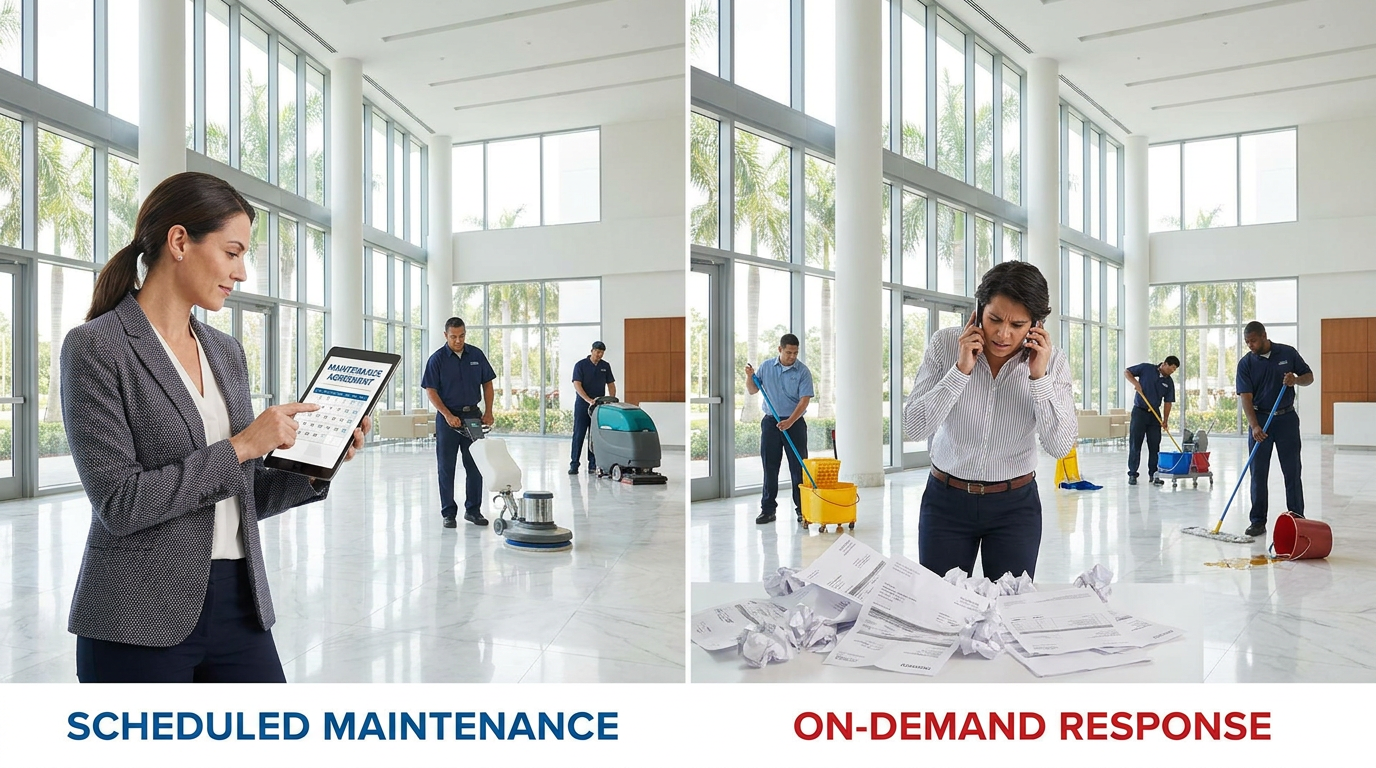
A scheduled floor care maintenance program costs 25-40% less annually than on-demand service for commercial facilities over 5,000 square feet. Maintenance programs in South Florida range from $0.15 to $0.35 per square foot monthly, while on-demand strip and wax services cost $0.80 to $1.20 per square foot per visit, with most facilities requiring 2-4 visits yearly.
- Maintenance programs save 25-40% annually compared to reactive on-demand services for facilities over 5,000 sq ft
- On-demand strip and wax costs $0.80 to $1.20 per square foot in Miami-Dade, Broward, and Palm Beach Counties
- Monthly maintenance programs range from $0.15 to $0.35 per square foot depending on floor type and traffic
- Break-even point occurs at approximately 3 service calls per year for most commercial facilities
- Healthcare and retail facilities see the highest ROI from scheduled programs due to compliance requirements
Total Cost of Ownership: Maintenance Programs vs On-Demand Services
The true cost of ownership for commercial floor care extends beyond the invoice price. According to ISSA research on floor care economics, over 90% of floor care costs come from labor, making service frequency the primary cost driver. A 10,000 square foot office in Fort Lauderdale paying for on-demand services 3 times yearly spends approximately $2,700 to $3,600 annually on strip and wax alone.
That same facility on a monthly maintenance program pays $1,500 to $3,500 annually, including regular scrub and recoat services that prevent the need for frequent full strip cycles. The maintenance approach also extends floor finish life by 40-60%, reducing material costs over a 5-year period.
Facility managers using a total cost of ownership calculator find that reactive services create hidden expenses: emergency scheduling fees (typically 15-25% premium), accelerated floor degradation, and increased slip-and-fall liability exposure. These factors rarely appear in initial quotes but significantly impact annual budgets.
Pricing Breakdown by Service Type in South Florida
Commercial floor care pricing varies significantly between Miami-Dade, Broward, and Palm Beach Counties. Understanding regional rates helps facility managers budget accurately and negotiate effectively with service providers.
| Service Type | On-Demand (Per Visit) | Program (Monthly) | Annual Savings |
|---|---|---|---|
| VCT Strip and Wax | $0.85-$1.20/sq ft | $0.18-$0.28/sq ft | 28-35% |
| Scrub and Recoat | $0.35-$0.55/sq ft | $0.12-$0.20/sq ft | 32-40% |
| Tile and Grout Deep Clean | $0.50-$0.85/sq ft | $0.15-$0.25/sq ft | 25-32% |
| Marble/Terrazzo Polish | $3.50-$6.00/sq ft | $0.45-$0.75/sq ft | 35-45% |
| Commercial Carpet | $0.25-$0.40/sq ft | $0.08-$0.15/sq ft | 30-38% |
These rates reflect 2026 pricing across South Florida commercial markets. Healthcare facilities, educational institutions, and retail spaces typically fall on the higher end due to compliance requirements and extended service hours. Warehouses and industrial facilities often qualify for volume discounts that reduce per-square-foot costs by 10-15%.
How Much to Charge for a 6,000 Square Foot Office
A 6,000 square foot office in South Florida should expect to pay between $4,800 and $7,200 annually for comprehensive floor care under a maintenance program. This includes quarterly commercial floor scrubbing and waxing and one annual full strip and wax service.
On-demand pricing for the same space breaks down differently. A single strip and wax visit costs $5,100 to $7,200 ($0.85-$1.20 per square foot). Most offices require this service 2-3 times annually without regular maintenance, pushing yearly costs to $10,200 to $21,600. The math clearly favors scheduled programs for facilities of this size.
According to industry discussions on Reddit's Custodians community, pricing between $0.20 and $0.50 per square foot represents the standard range for floor maintenance, with variation based on flooring type, condition, and local market factors.
Is 30 Cents Per Square Foot Good for Stripping and Waxing?
Thirty cents per square foot for stripping and waxing is below market rate and should raise questions about service quality. Standard commercial strip and wax pricing in South Florida ranges from $0.80 to $1.20 per square foot for one-time services. A quote of $0.30 per square foot likely indicates one of three scenarios.
First, the provider may be quoting a scrub and recoat service rather than a full strip. Scrub and recoat removes only the top layer of finish and applies 1-2 new coats, taking 60-70% less time than stripping. Second, the quote may exclude critical steps like edge work, baseboard cleaning, or proper floor preparation. Third, the provider may be using inferior products that require more frequent reapplication.
For maintenance program pricing, $0.30 per square foot monthly represents a mid-range rate that includes regular scrubbing with periodic full strip services spread across the contract term. Always clarify whether quotes cover one-time services or monthly program rates to avoid budget surprises.
When On-Demand Services Make Financial Sense
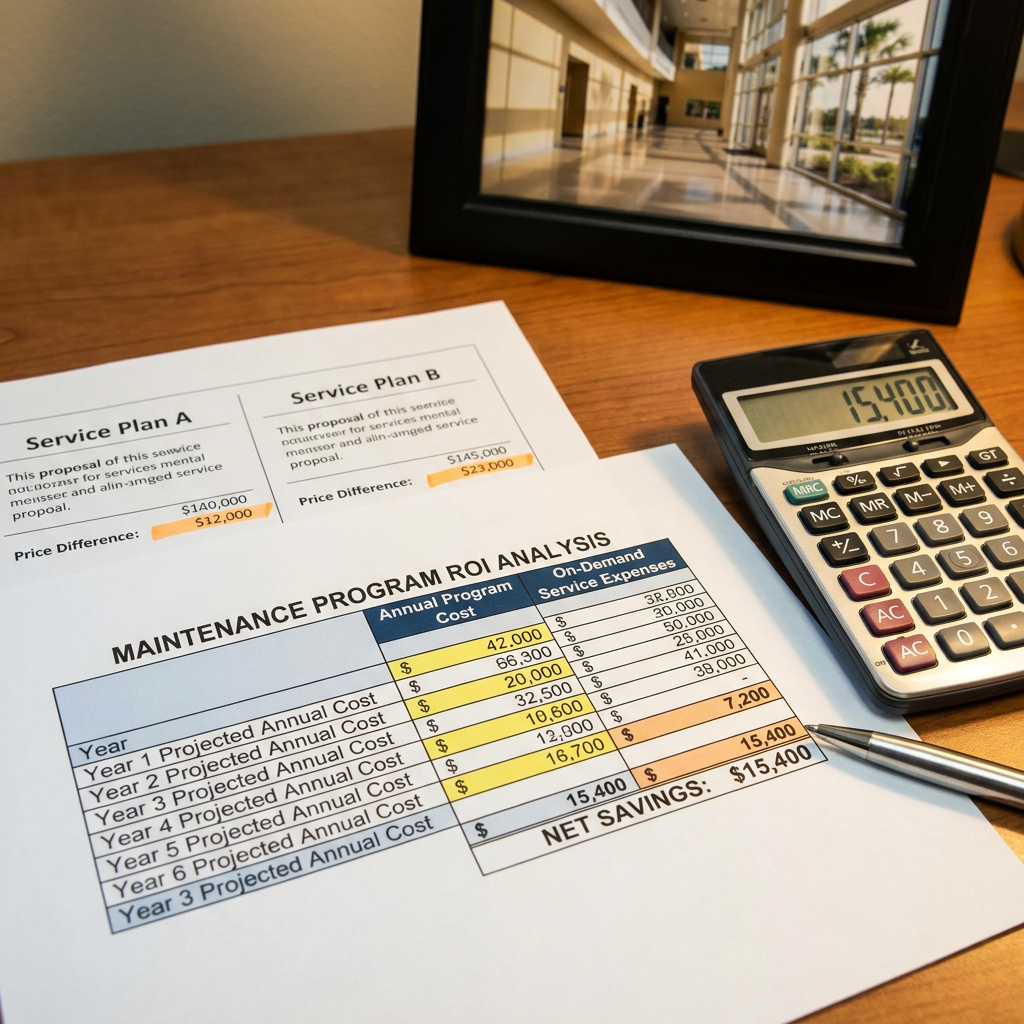
On-demand floor care services deliver better value than maintenance programs in specific situations. Facilities under 3,000 square feet often find that program minimums exceed their actual service needs. A 2,500 square foot medical office requiring service twice yearly pays less with on-demand pricing than a monthly contract with minimum fees.
Seasonal businesses, including certain retail locations and hospitality venues, benefit from on-demand flexibility. A beachfront restaurant in Miami Beach needing intensive floor restoration before peak season and minimal maintenance during slow months wastes money on year-round contracts.
Properties undergoing renovation or facing uncertain lease terms should avoid long-term commitments. On-demand services provide necessary maintenance without contractual obligations that complicate property transitions. However, once operations stabilize, transitioning to a maintenance program typically reduces costs within the first year.
When Maintenance Programs Deliver Superior ROI
Maintenance programs consistently outperform on-demand services for facilities with predictable, ongoing floor care requirements. Research from Diverzify confirms that effective flooring maintenance programs protect investments and extend product life across commercial facilities.
Healthcare facilities represent the strongest case for scheduled programs. Hospitals, clinics, and medical offices face Joint Commission and OSHA compliance requirements that mandate documented cleaning schedules. On-demand services create compliance gaps and audit risks. A maintenance program with commercial tile and grout cleaning scheduled quarterly ensures consistent documentation and inspection readiness.
High-traffic retail environments, educational institutions, and multi-tenant office buildings also see significant returns from scheduled maintenance. These facilities experience 15-25% faster floor finish degradation than average commercial spaces. Regular scrub and recoat services every 4-6 weeks prevent the buildup that necessitates costly full strip procedures.
Cost Comparison: 10,000 Square Foot Medical Clinic
A real-world comparison illustrates the financial impact of service model selection. Consider a 10,000 square foot medical clinic in Broward County with VCT flooring in patient areas, tile in restrooms and break rooms, and carpet in administrative offices.
| Cost Category | On-Demand Annual | Program Annual |
|---|---|---|
| VCT Strip and Wax (6,000 sq ft) | $15,300 (3 visits) | $12,960 |
| Tile Deep Clean (2,500 sq ft) | $4,250 (2 visits) | $3,750 |
| Carpet Cleaning (1,500 sq ft) | $1,200 (2 visits) | $1,080 |
| Emergency/Rush Fees | $1,800 (estimated) | $0 |
| Scheduling Coordination Time | $1,500 (staff hours) | $300 |
| Total Annual Cost | $24,050 | $18,090 |
The maintenance program delivers $5,960 in annual savings, representing a 24.8% cost reduction. Over a typical 5-year facility management period, this translates to nearly $30,000 in preserved budget, excluding the extended floor life that further reduces replacement costs.
How Long Does Deep Cleaning Take for Commercial Spaces
Deep cleaning timeframes directly impact operational costs and scheduling decisions. A 2,000 square foot commercial space requires 4-6 hours for comprehensive floor deep cleaning, including equipment setup, cleaning, and drying time. This benchmark scales predictably for larger facilities.
For a 6,000 square foot office, expect 10-14 hours for a full strip and wax service. Commercial floor deep cleaning without stripping takes 6-8 hours for the same space. These timeframes assume after-hours scheduling, which most South Florida commercial cleaning providers offer to minimize business disruption.
Maintenance program services complete faster because they address smaller areas of concern rather than facility-wide restoration. Monthly scrub and recoat services for a 6,000 square foot facility typically finish in 3-4 hours, allowing completion during a single overnight shift.
Factors That Increase Floor Care Costs
Several variables push floor care costs above baseline estimates. Understanding these factors helps facility managers budget accurately and identify cost reduction opportunities.
Floor condition and age: Floors with heavy buildup, ground-in soil, or damaged finish require additional preparation time. Severely neglected floors may need multiple strip cycles before accepting new finish properly, increasing labor costs by 30-50%.
Flooring material complexity: Specialty surfaces like marble and terrazzo require diamond honing equipment and specialized technicians. These services cost 3-5 times more than standard VCT maintenance but protect flooring investments that often exceed $15 per square foot installed.
Access and scheduling constraints: Facilities requiring daytime service, weekend-only access, or work around active patient care areas incur 15-25% premiums. Healthcare facilities with strict infection control protocols may require additional preparation and documentation time.
Geographic location: Palm Beach County rates run 5-10% higher than Broward County, with Miami-Dade falling in between. Travel time and local labor market conditions drive these regional variations.
Building Your Floor Care Maintenance Program
The Budd Group's facility maintenance research identifies three essential tiers for comprehensive floor care: regular maintenance, periodic deep cleaning, and restorative services. Effective programs balance all three to maximize floor life while controlling costs.
Daily and weekly maintenance includes dust mopping, spot cleaning, and auto-scrubbing high-traffic areas. These tasks typically fall under janitorial contracts rather than specialized floor care programs. Proper daily maintenance reduces the frequency of intensive services by 20-30%.
Monthly or quarterly services address accumulated soil and finish wear through scrub and recoat procedures. This middle tier prevents the deterioration that triggers expensive full strip services. Most commercial facilities benefit from monthly scrubbing with quarterly recoating.
Annual or semi-annual restoration includes full strip and wax, deep grout cleaning, and surface refinishing. Scheduling these services during slow business periods minimizes operational impact while ensuring floors meet appearance and safety standards year-round.
Contract Terms and Negotiation Strategies
Floor care maintenance contracts typically run 12-36 months, with longer terms offering 5-15% discounts. However, longer commitments carry risks if service quality declines or facility needs change. Optimal contract structure balances cost savings with operational flexibility.
Request performance guarantees tied to measurable outcomes: gloss meter readings for waxed floors, slip coefficient testing for safety compliance, and documented response times for service requests. These metrics create accountability and provide grounds for contract remediation if standards slip.
Include provisions for service frequency adjustments based on actual floor condition. A well-maintained floor may need less frequent full strip services than initially estimated. Contracts that allow downward adjustments prevent overpaying for unnecessary work while maintaining the program relationship.
Verify insurance coverage before signing any floor care contract. Providers should carry general liability insurance of at least $1 million per occurrence and workers compensation coverage. Request certificates of insurance naming your facility as an additional insured party.
Choosing Between Local and National Providers
National franchise operations like ServiceMaster, Jani-King, and SERVPRO offer brand recognition and standardized processes. Local providers deliver personalized service and often lower overhead costs. The right choice depends on facility priorities and management preferences.
National providers excel at multi-location consistency. A retail chain with stores across Miami-Dade, Broward, and Palm Beach Counties benefits from unified service standards and centralized billing. However, national brands typically charge 10-20% premiums to cover franchise fees and corporate overhead.
Local commercial cleaning companies often provide more flexible scheduling, faster emergency response, and direct access to ownership when issues arise. A provider serving 150+ businesses across South Florida understands regional challenges like humidity-related floor care concerns and hurricane season preparation requirements.
Evaluate providers based on specific capabilities rather than brand size. Request references from facilities similar to yours in size, industry, and floor types. A provider with extensive healthcare experience may not suit a warehouse operation, regardless of their overall reputation.
Hidden Costs to Include in Your Comparison
Accurate cost comparison requires accounting for expenses that rarely appear in initial quotes. These hidden costs often determine whether maintenance programs or on-demand services deliver better value for specific facilities.
Coordination and management time: On-demand services require staff time to identify needs, request quotes, schedule services, and supervise work. Facility managers report spending 3-5 hours per service event on coordination. At loaded labor costs of $35-50 per hour, this adds $105-250 per service call.
Business disruption: Unscheduled floor care creates productivity losses when employees work around cleaning crews or facilities close unexpectedly. Maintenance programs with fixed schedules allow staff planning and minimize disruption costs.
Floor replacement acceleration: Reactive maintenance shortens floor life by allowing damage to accumulate before treatment. VCT flooring properly maintained lasts 15-20 years; poorly maintained floors require replacement in 8-12 years. At $3-5 per square foot installed, premature replacement represents significant unplanned capital expense.
Liability exposure: Slip-and-fall incidents on poorly maintained floors create legal and insurance costs. OSHA reports that falls account for over 25% of workplace injuries. Regular maintenance programs with documented service records demonstrate due diligence that protects against negligence claims.
Calculating Your Facility's Break-Even Point
The break-even point between maintenance programs and on-demand services depends on your facility's specific characteristics. Use this framework to determine which approach delivers better value for your operation.
Step 1: Calculate your current annual floor care spending, including all service invoices, staff coordination time, and any emergency or rush fees paid in the past 12 months.
Step 2: Request maintenance program quotes from at least three providers. Ensure quotes cover the same scope of services for accurate comparison. Include all floor types and areas in your facility.
Step 3: Add 15% to on-demand cost estimates for emergency services and coordination overhead. Subtract 10% from maintenance program quotes to account for reduced emergency needs and administrative efficiency.
Step 4: Compare adjusted totals. If maintenance programs cost within 10% of adjusted on-demand spending, the program likely delivers better long-term value through extended floor life and reduced management burden.
Most facilities over 5,000 square feet reach break-even at 2.5-3 on-demand service calls annually. Facilities requiring 4 or more annual services almost always benefit from structured maintenance programs.
Frequently Asked Questions
How much does Stanley Steemer charge to clean wood floors?
Stanley Steemer charges $0.35-$0.65 per square foot for hardwood floor cleaning, with most residential jobs falling between $150 and $350. Commercial rates run higher due to equipment requirements and scheduling complexity. However, Stanley Steemer primarily serves residential markets. Commercial facilities benefit from providers specializing in business environments with appropriate insurance, after-hours availability, and commercial-grade equipment.
What is included in a typical floor care maintenance program?
Standard maintenance programs include monthly auto-scrubbing, quarterly scrub and recoat services, and annual full strip and wax. Additional services like commercial carpet cleaning, tile and grout restoration, and specialty surface care can be bundled for comprehensive coverage. Programs should specify service frequencies, products used, and performance standards in writing.
Can I switch from on-demand to a maintenance program mid-year?
Yes, most providers accept new maintenance contracts at any time. However, floors in poor condition may require initial restoration services before transitioning to maintenance mode. Budget for one-time restoration costs of $0.75-$1.50 per square foot to bring neglected floors up to maintainable condition before starting a program.
How do I verify a floor care provider's quality before signing a contract?
Request references from facilities similar to yours and conduct site visits to see their work firsthand. Ask for documentation of technician training, product specifications, and equipment maintenance schedules. Verify insurance coverage and request a sample service report to understand their documentation standards. Reputable providers welcome this scrutiny.
Making Your Decision
The choice between floor care maintenance programs and on-demand services ultimately depends on facility size, floor types, traffic patterns, and management priorities. Facilities over 5,000 square feet with consistent operational schedules almost always benefit from structured maintenance programs that deliver 25-40% annual savings.
Smaller facilities, seasonal operations, and properties facing uncertain futures may find on-demand flexibility more valuable than program discounts. The key is honest assessment of your actual service needs and total cost of ownership rather than simple invoice comparison.
South Florida's humidity and year-round traffic patterns create unique floor care challenges that favor proactive maintenance over reactive restoration. A free on-site assessment from an experienced commercial floor care provider can identify specific opportunities for your facility and provide accurate cost projections for both service models.
Get Your Custom Floor Care Cost Analysis
MB Floor Solutions serves 150+ businesses across Miami-Dade, Broward, and Palm Beach Counties. Request a free on-site assessment to compare maintenance program and on-demand pricing for your specific facility.
Request Free Assessment