Learn daily, weekly, and monthly VCT floor maintenance routines that extend professional service intervals. Expert tips for facility managers in South Florida.
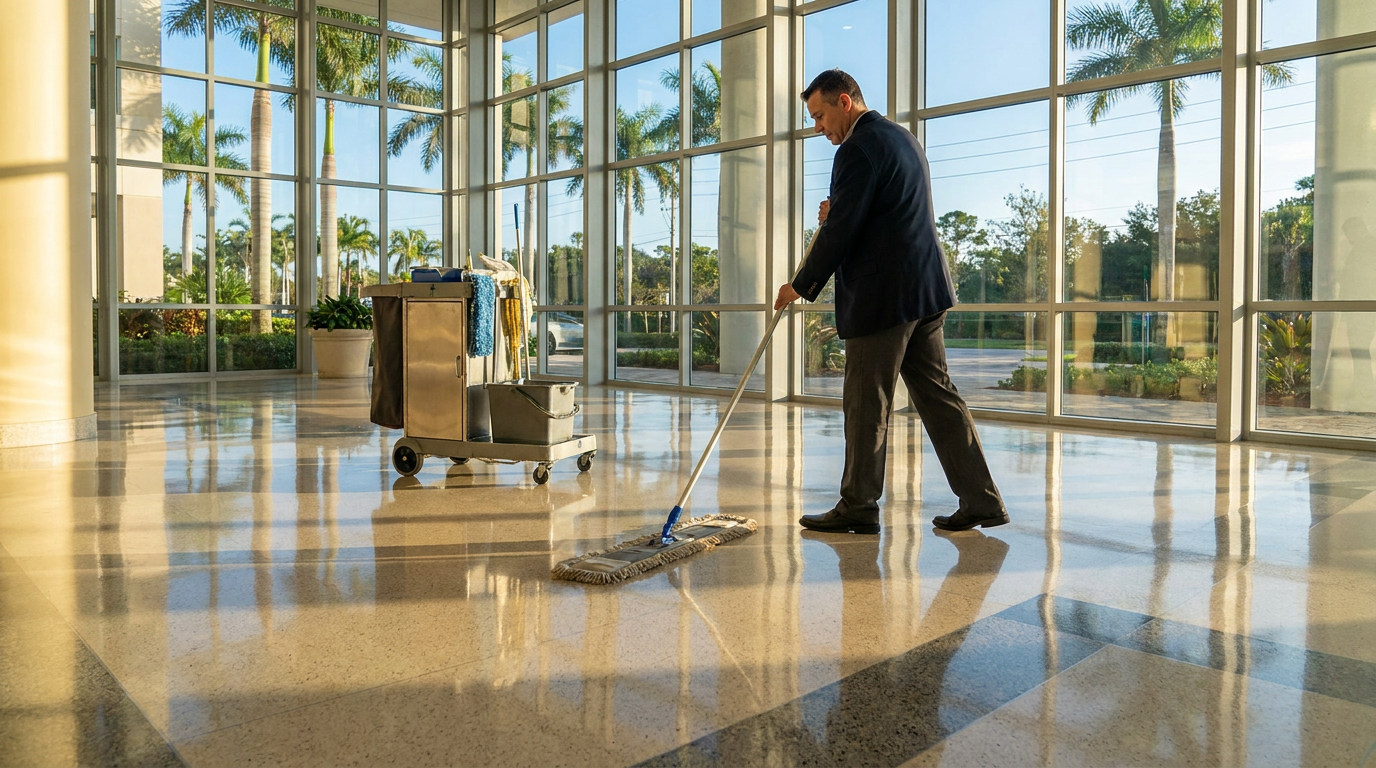
VCT floor maintenance between professional strip and wax services requires daily dust mopping, weekly wet mopping with neutral pH cleaner, and monthly spray buffing to preserve finish integrity. Following this three-tier approach extends professional service intervals from 6 months to 12 months, reducing annual floor care costs by 40 to 50 percent for commercial facilities.
- Daily dust mopping removes 80 percent of abrasive particles that damage floor finish
- Use only neutral pH cleaners (pH 7 to 9) to prevent finish breakdown and yellowing
- Monthly spray buffing with high-speed burnisher restores 85 to 90 percent of original gloss
- Proper maintenance extends strip and wax intervals from 6 months to 12 months
- Walk-off mats at entrances reduce soil infiltration by up to 70 percent
Understanding VCT Floor Composition and Why Maintenance Matters
Vinyl Composition Tile consists of limestone, filler materials, thermoplastic binders, and color pigments compressed under high pressure. According to Armstrong Flooring, VCT remains one of the most durable commercial flooring options when properly maintained, with a lifespan exceeding 25 years in high-traffic environments.
Unlike luxury vinyl tile or sheet vinyl, VCT requires a protective floor finish (commonly called wax) to resist staining, scuffing, and wear. This finish layer absorbs daily abuse instead of the tile itself. When the finish degrades, soil embeds directly into the porous tile surface, causing permanent discoloration.
South Florida facilities face additional challenges from humidity levels averaging 75 to 85 percent, sand tracked from beaches and parking lots, and frequent rain creating wet entry conditions. These factors accelerate finish breakdown and require more diligent maintenance protocols than facilities in drier climates.
The Three-Phase VCT Maintenance System
Effective VCT maintenance follows what industry professionals call the Rule of 3: daily cleaning, periodic maintenance, and restorative care. According to Imperial Dade's facility guide, facilities that implement all three phases reduce floor care costs by 35 to 45 percent annually compared to reactive maintenance approaches.
Each phase builds upon the previous one. Skipping daily cleaning accelerates the need for periodic maintenance. Neglecting periodic maintenance forces premature restorative services. Understanding this relationship helps facility managers budget time and resources effectively.
| Maintenance Phase | Frequency | Time Required | Equipment Needed |
|---|---|---|---|
| Daily Cleaning | Every day | 15 to 30 minutes per 5,000 sq ft | Dust mop, wet mop, neutral cleaner |
| Periodic Maintenance | Weekly to monthly | 45 to 90 minutes per 5,000 sq ft | Auto-scrubber, burnisher, spray buff solution |
| Restorative Care | Every 6 to 12 months | 4 to 8 hours per 5,000 sq ft | Stripping chemicals, floor machine, finish applicator |
Daily VCT Floor Cleaning Protocol
Daily cleaning removes surface soil before it bonds to the floor finish. According to ServiceMaster Clean, 80 percent of floor finish damage comes from abrasive particles tracked in from outside. Removing these particles daily prevents microscopic scratches that dull appearance and create soil adhesion points.
Dust Mopping Procedure
Begin each day with thorough dust mopping before foot traffic increases. Use a commercial dust mop treated with dust mop treatment spray, which attracts and holds particles rather than pushing them around. Work in straight lines, overlapping each pass by 2 to 3 inches.
For facilities exceeding 10,000 square feet, consider battery-powered walk-behind dust mop machines that cover 20,000 square feet per hour. These machines reduce labor time by 60 percent compared to manual dust mopping while providing more consistent results.
Wet Mopping Best Practices
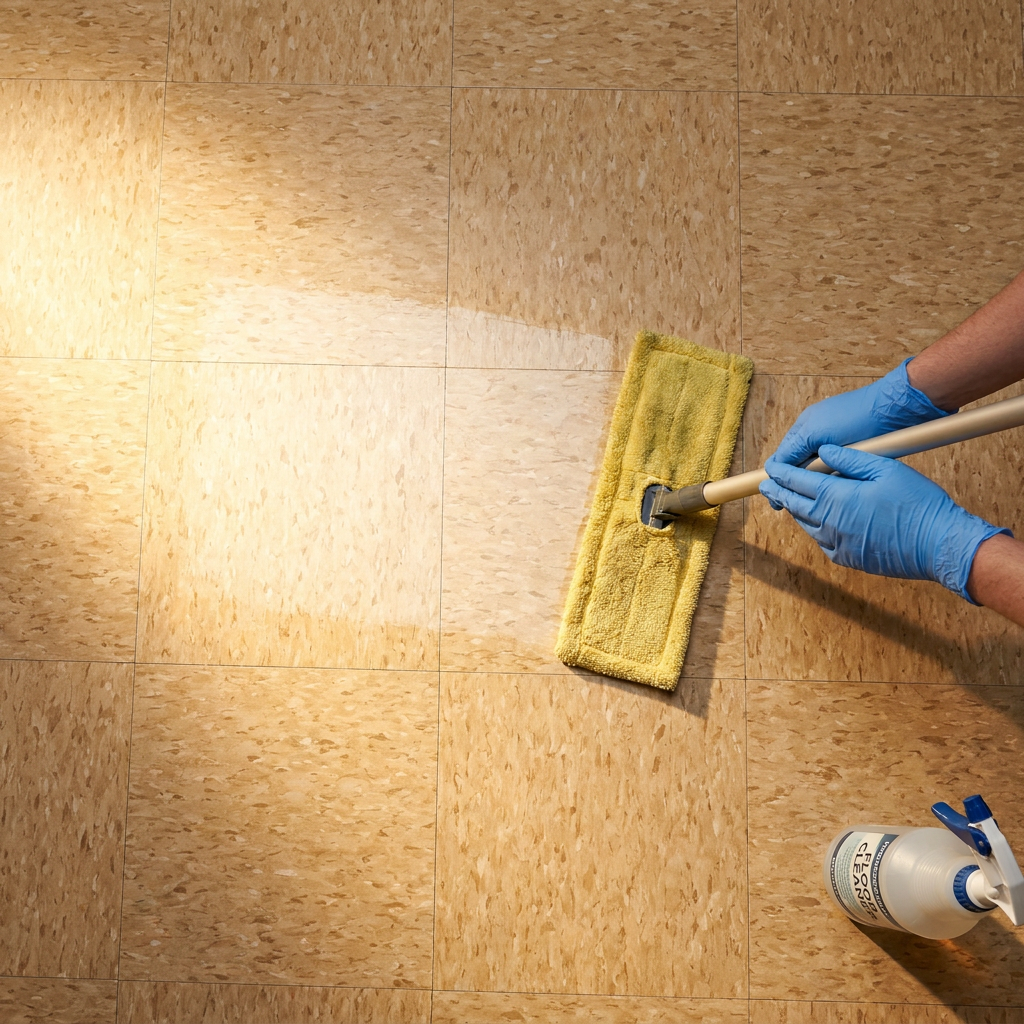
Wet mop high-traffic areas daily using a neutral pH floor cleaner diluted according to manufacturer specifications. The cleaning solution should measure between pH 7 and pH 9. Alkaline cleaners above pH 10 strip floor finish prematurely. Acidic cleaners below pH 6 etch the tile surface.
Use a two-bucket system: one bucket contains cleaning solution, the other contains rinse water. Wring mops thoroughly to prevent excess moisture from seeping into tile seams. VCT adhesive degrades when exposed to standing water, causing tiles to lift at edges.
Allow floors to dry completely before allowing foot traffic. In South Florida's humidity, drying takes 15 to 25 minutes with adequate HVAC operation. Using fans accelerates drying to 8 to 12 minutes.
Weekly Maintenance Tasks
Weekly maintenance addresses soil accumulation that daily cleaning cannot remove. Auto-scrubbing and edge cleaning during this phase prevents the buildup that eventually requires aggressive restoration.
Auto-Scrubber Operation
Run an auto-scrubber with red or blue cleaning pads across all VCT surfaces weekly. Set solution flow to medium and maintain consistent walking speed of 2 to 3 miles per hour. Overlapping passes by 2 inches ensures complete coverage without missed strips.
For facilities in Miami-Dade, Broward, and Palm Beach Counties, weekly auto-scrubbing is particularly important due to higher sand and soil loads from coastal environments. Sand particles act like sandpaper, grinding away floor finish with every footstep.
Edge and Corner Cleaning
Auto-scrubbers cannot reach within 3 to 6 inches of walls, fixtures, and corners. Use a swing machine with appropriate pad or hand scrub these areas weekly. Neglected edges develop dark buildup lines that become permanent without professional intervention.
Pay special attention to areas beneath desks, behind doors, and around fixed equipment. These zones accumulate soil that migrates into traffic lanes during normal activity.
Monthly Spray Buffing and Burnishing
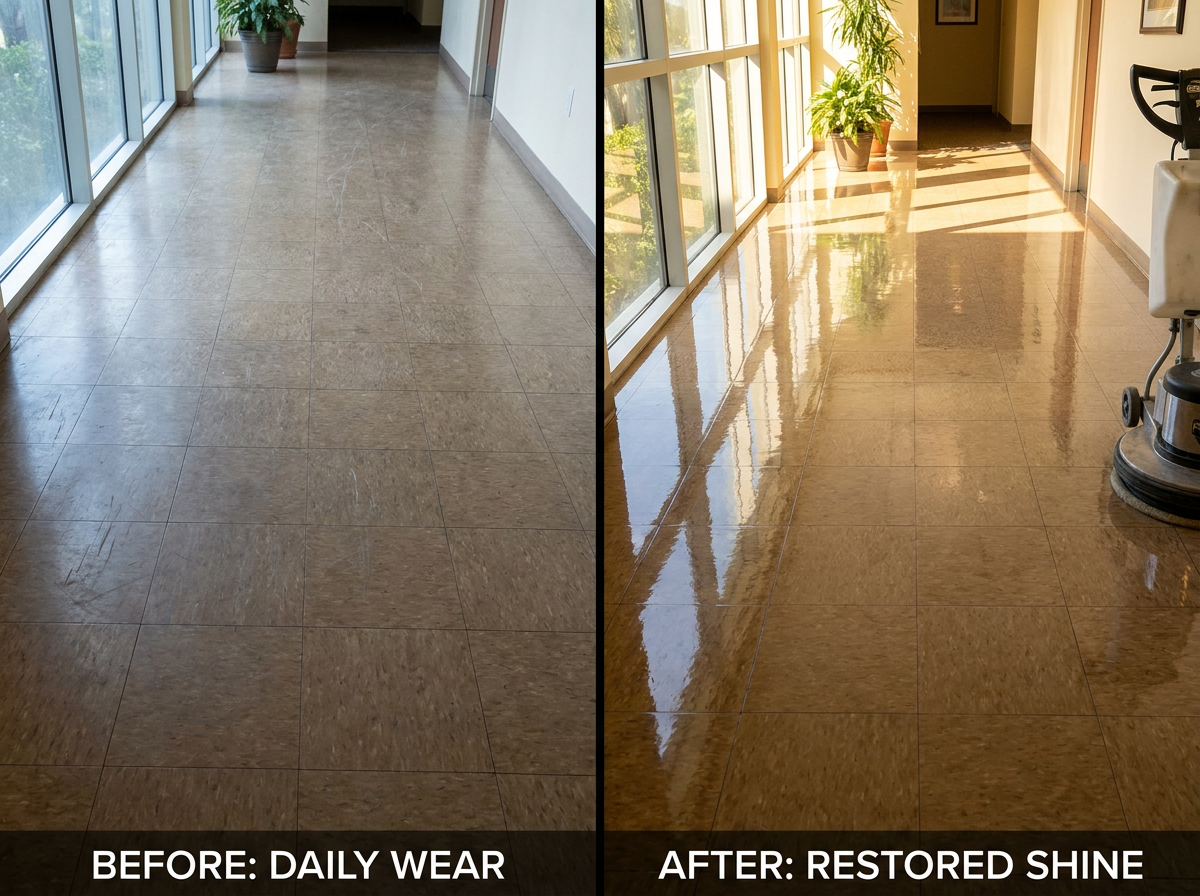
Monthly spray buffing restores gloss and repairs minor finish damage without applying new coats. This process uses friction heat to redistribute existing finish, filling microscopic scratches and restoring uniform appearance.
Spray Buffing Procedure
Apply spray buff solution in a light mist ahead of a high-speed burnisher operating at 1,500 to 2,000 RPM. Use a natural fiber or synthetic blend pad designed for spray buffing. Work in overlapping passes, allowing the pad to do the work without excessive downward pressure.
Spray buffing restores 85 to 90 percent of original gloss when performed monthly. Facilities that skip this step require professional floor scrubbing and waxing services twice as often.
When to Burnish Without Spray Buff
Dry burnishing with ultra-high-speed machines (2,000 to 3,000 RPM) works well for floors in excellent condition. This process generates enough heat to melt and redistribute finish without additional product. Reserve dry burnishing for floors with minimal scratching and consistent finish depth.
Choosing the Right Cleaning Products
Product selection directly impacts maintenance effectiveness and finish longevity. Using incorrect products causes more damage than no maintenance at all.
| Product Type | Recommended pH | Use Case | Brands |
|---|---|---|---|
| Neutral Floor Cleaner | 7 to 9 | Daily wet mopping | Betco pH7Q, Diversey Stride, 3M Neutral Cleaner |
| Spray Buff Solution | 8 to 9 | Monthly burnishing | Zep Spray Buff, Spartan Spraybuff, JohnsonDiversey |
| Floor Finish Restorer | 8 to 10 | Quarterly touch-up | Betco Hybrid, Diversey Carefree Matte |
| Dust Mop Treatment | N/A | Daily dust mopping | Rubbermaid Dust Mop Treatment, 3M Easy Trap |
Common VCT Maintenance Mistakes to Avoid
Even well-intentioned maintenance efforts cause damage when executed incorrectly. These mistakes account for 60 percent of premature floor restoration needs according to industry surveys from the International Sanitary Supply Association (ISSA).
Using Excessive Water
VCT tiles are porous and absorb moisture through seams. Excessive water penetrates beneath tiles, degrading adhesive bonds and causing edges to curl upward. Always wring mops until nearly dry and never flood floors with cleaning solution.
Applying Wrong Cleaning Products
All-purpose cleaners, vinegar solutions, and degreasing agents strip floor finish rapidly. One application of an alkaline degreaser removes 2 to 3 coats of finish. Use only products specifically formulated for finished VCT floors.
Skipping Dust Mopping
Wet mopping without prior dust mopping creates mud that embeds into finish pores. This embedded soil creates gray, hazy appearance that no amount of buffing corrects. Always dust mop before any wet cleaning process.
Using Dirty Mop Water
Continuing to mop with dirty water spreads soil rather than removing it. Change mop water when it becomes visibly cloudy, typically every 500 to 800 square feet depending on soil load.
Preventive Measures That Reduce Maintenance Burden
Preventing soil from reaching VCT surfaces reduces cleaning frequency and extends finish life. Implementing these measures cuts maintenance labor by 25 to 35 percent annually.
Walk-Off Mat Systems
Install commercial-grade walk-off mats at all exterior entrances. According to the Carpet and Rug Institute, properly sized mats (minimum 15 feet of walking distance) capture 70 to 80 percent of tracked-in soil. Replace or clean mats weekly to maintain effectiveness.
In South Florida, consider mats with moisture-wicking properties to handle rain and humidity. Wet mats transfer moisture to floors, negating their protective benefit.
Furniture Protection
Install felt or rubber floor protectors on all furniture legs. Chair casters should be soft rubber or polyurethane rated for hard floors. Hard plastic casters create scratches and divots that trap soil and damage finish.
Traffic Pattern Management
Rearrange furniture periodically to distribute wear across floor surfaces. Concentrated traffic lanes wear through finish 3 to 4 times faster than low-traffic areas, creating visible paths that require spot restoration.
Signs Your VCT Floor Needs Professional Attention
Despite diligent maintenance, VCT floors eventually require professional restoration. Recognizing these signs prevents permanent damage that increases restoration costs.
Yellowing or discoloration: Indicates finish breakdown from UV exposure, improper cleaning products, or age. Professional stripping removes degraded finish layers.
Black heel marks that do not buff out: Suggests finish has worn thin, allowing marks to penetrate to tile surface. Requires scrub and recoat or full strip and wax.
Visible wear patterns: Traffic lanes showing different sheen than surrounding areas indicate uneven finish depth. Professional floor stripping and waxing restores uniform appearance.
Finish peeling or flaking: Results from moisture infiltration, incompatible products, or application over contaminated surfaces. Requires complete stripping and proper preparation before refinishing.
Embedded soil creating gray haze: Indicates soil has penetrated finish layers. Standard maintenance cannot remove embedded contamination; professional deep cleaning with commercial floor deep cleaning services is required.
Creating a VCT Maintenance Schedule for Your Facility
Effective maintenance requires documented schedules with assigned responsibilities. Facilities without written protocols experience 40 percent more floor damage than those with formal programs.
Sample Weekly Schedule
Monday through Friday: Dust mop all VCT areas before opening. Wet mop high-traffic zones (entrances, hallways, break rooms) daily. Spot clean spills immediately.
Saturday or Sunday: Auto-scrub entire VCT floor area. Clean edges and corners with swing machine. Inspect for damage requiring attention.
Sample Monthly Schedule
Week 1: Spray buff all VCT areas with high-speed burnisher. Inspect and replace worn walk-off mats.
Week 2: Deep clean edges, corners, and areas beneath furniture. Check furniture protectors for wear.
Week 3: Standard weekly maintenance only.
Week 4: Assess overall floor condition. Document areas showing wear for professional attention. Schedule quarterly or annual services as needed.
Cost Comparison: DIY Maintenance vs. Professional Services
Understanding cost implications helps facility managers balance in-house maintenance with professional services for optimal budget efficiency.
| Service Type | DIY Cost (per 5,000 sq ft) | Professional Cost | Frequency |
|---|---|---|---|
| Daily Cleaning | $15 to $25 labor plus supplies | Included in janitorial contract | Daily |
| Auto-Scrubbing | $40 to $60 labor plus supplies | $75 to $125 | Weekly |
| Spray Buffing | $50 to $80 labor plus supplies | $100 to $175 | Monthly |
| Scrub and Recoat | Not recommended DIY | $0.35 to $0.55 per sq ft | Quarterly |
| Strip and Wax | Not recommended DIY | $0.85 to $1.15 per sq ft | Annually |
For facilities in Miami-Dade, Broward, and Palm Beach Counties, professional strip and wax services typically range from $0.80 to $1.20 per square foot depending on location and floor condition. Proper interim maintenance extends service intervals, reducing annual professional service costs by $2,000 to $4,000 for a typical 10,000 square foot facility.
Frequently Asked Questions About VCT Floor Maintenance
How do you maintain VCT floors?
Maintain VCT floors through a three-phase approach: daily dust mopping and spot wet mopping, weekly auto-scrubbing of entire floor areas, and monthly spray buffing to restore gloss. Use only neutral pH cleaners between pH 7 and 9. Avoid excessive water and never use all-purpose cleaners or vinegar solutions on finished VCT.
What is the Rule of 3 in flooring?
The Rule of 3 in floor maintenance refers to three essential care phases: daily cleaning (dust mopping and spot cleaning), periodic maintenance (weekly scrubbing and monthly buffing), and restorative care (professional strip and wax services). Each phase prevents the need for more aggressive intervention, creating a sustainable maintenance cycle that protects floor investment.
How often should you wax a VCT floor?
VCT floors require professional strip and wax services every 6 to 12 months depending on traffic levels and maintenance quality. High-traffic facilities (retail, healthcare, schools) typically need service every 6 to 8 months. Office environments with proper interim maintenance can extend intervals to 10 to 12 months. Monthly spray buffing between services maintains appearance without adding new finish coats.
Do you need to seal VCT flooring?
VCT flooring requires floor finish (commonly called wax or sealer) to protect the porous tile surface from staining and wear. New VCT should receive 3 to 5 coats of commercial floor finish after installation. Unlike some flooring types, VCT cannot be left unfinished in commercial environments; the tile absorbs soil and liquids without protective finish layers.
Partner With South Florida's VCT Floor Experts
Maintaining VCT floors between professional services requires consistent effort and proper technique. When your floors need professional attention, whether scrub and recoat services to refresh appearance or complete strip and wax restoration, working with experienced technicians ensures optimal results.
MB Floor Solutions serves over 150 businesses across Miami-Dade, Broward, and Palm Beach Counties, maintaining more than 1 million square feet of commercial flooring. Our team provides comprehensive commercial cleaning services including VCT floor care, with 24/7 scheduling and after-hours availability to minimize business disruption.
For facilities requiring ongoing support, we offer customized maintenance programs that combine your in-house daily efforts with our periodic professional services. This partnership approach delivers consistently excellent floors while optimizing your maintenance budget.
Schedule Your Free Floor Assessment
Our technicians evaluate your VCT floors, identify maintenance gaps, and recommend a customized care program. Contact MB Floor Solutions at (954) 380-3050 or request your free on-site assessment today.
Get Your Free Assessment